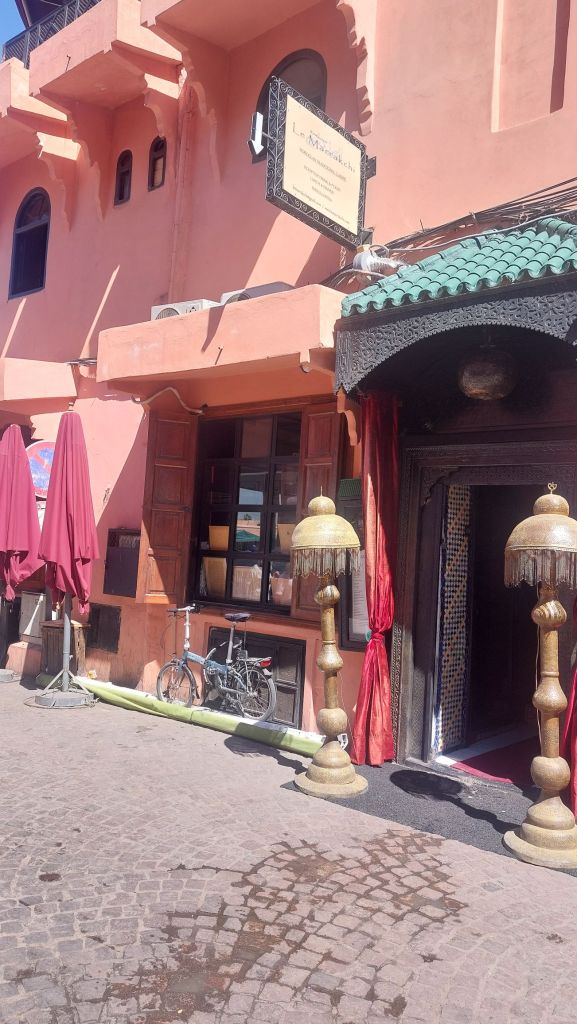
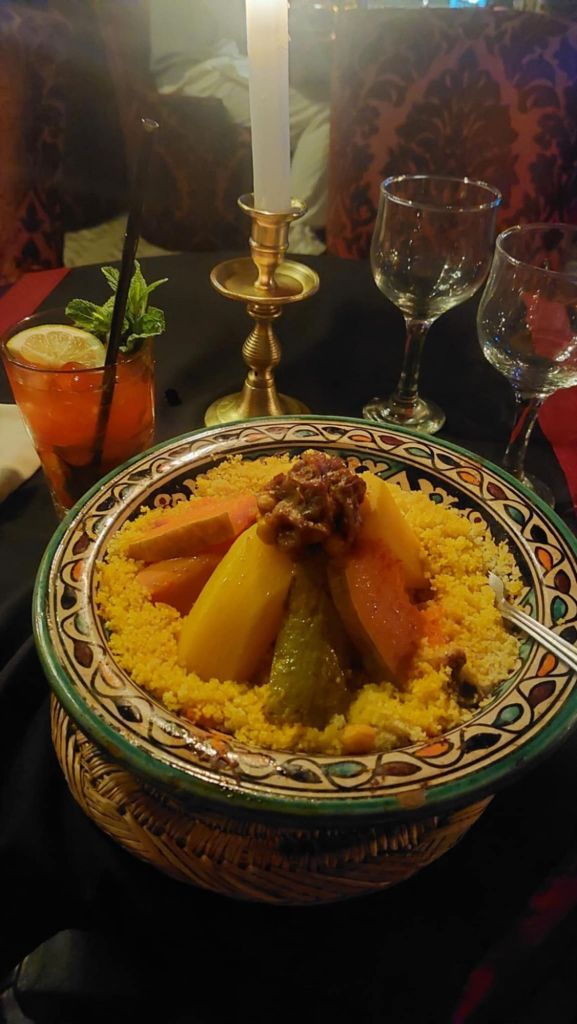
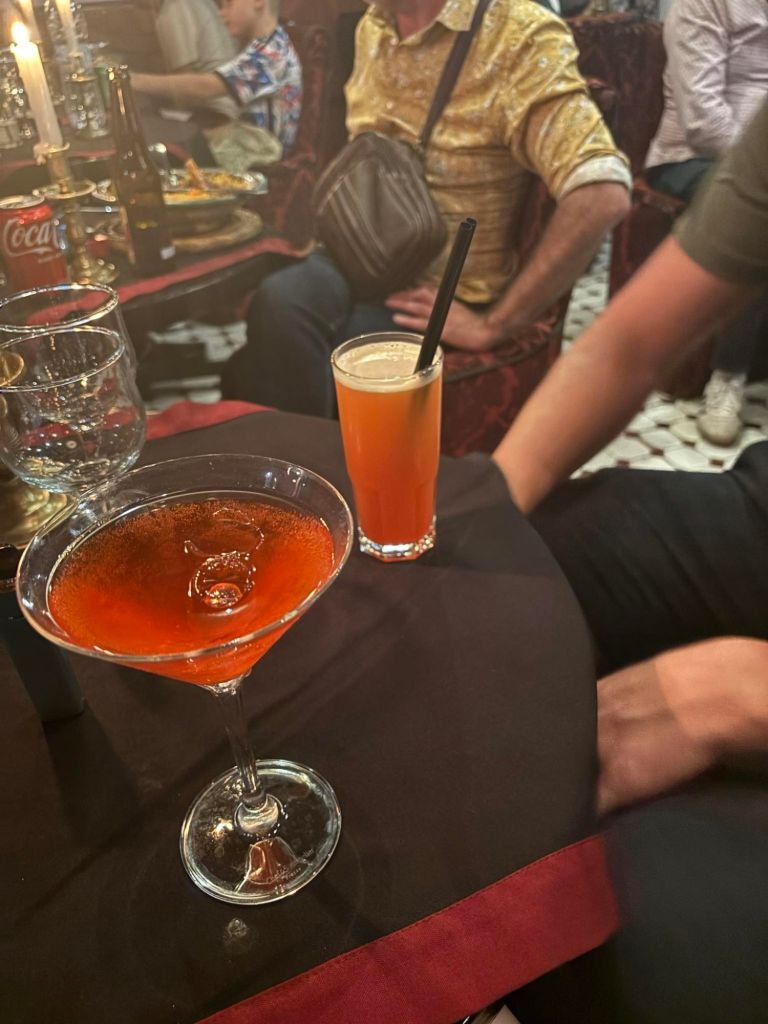
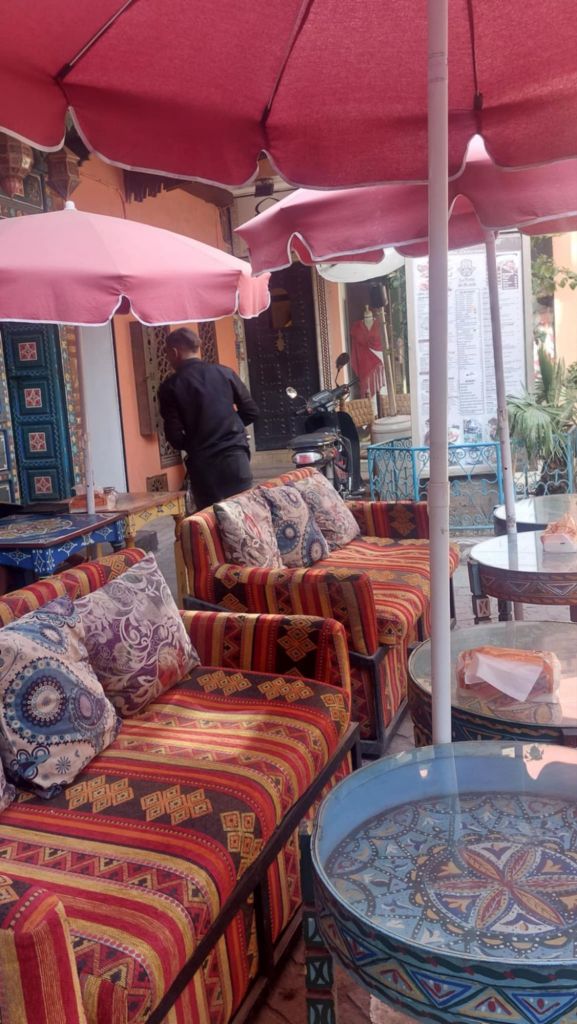
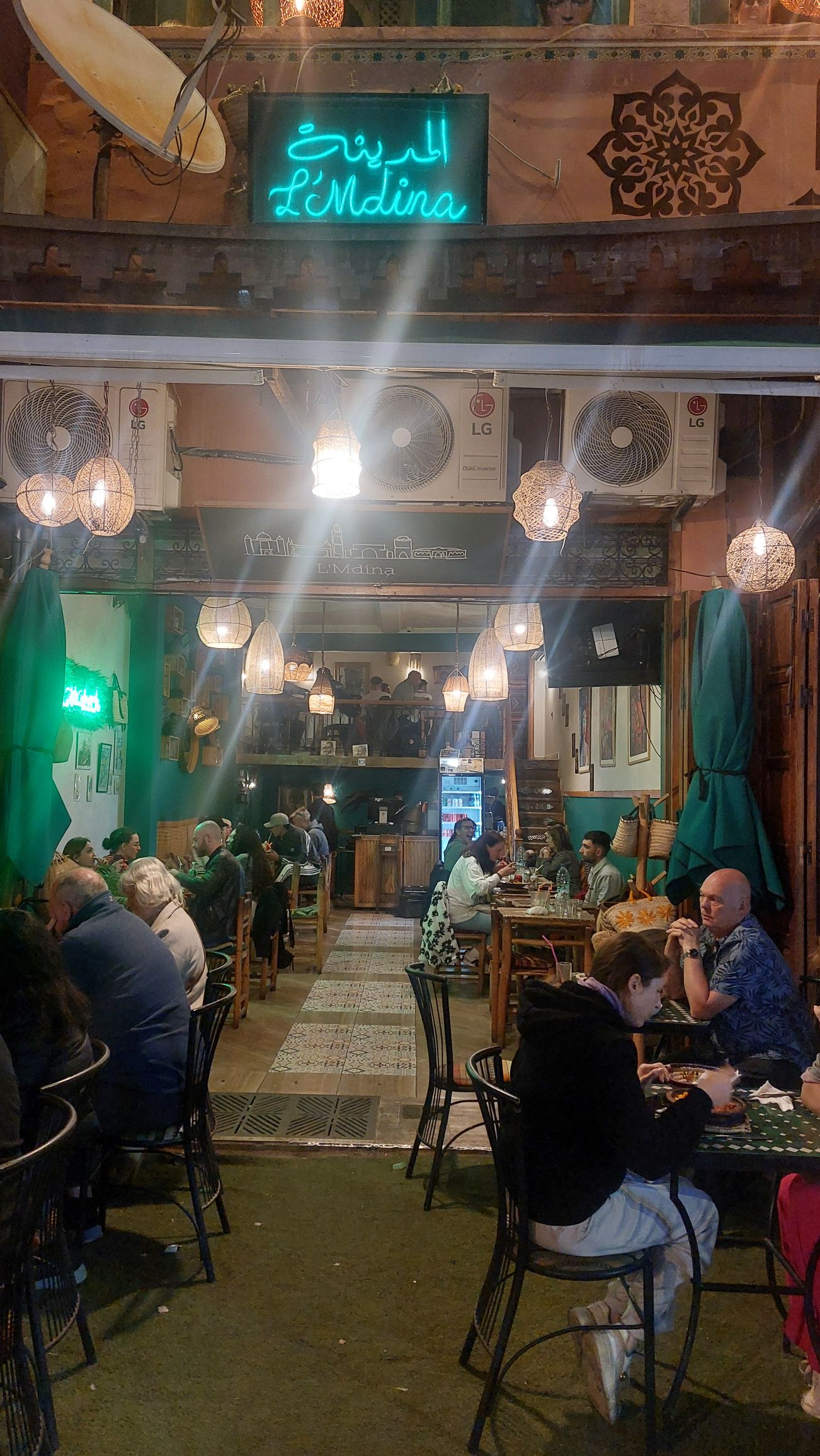
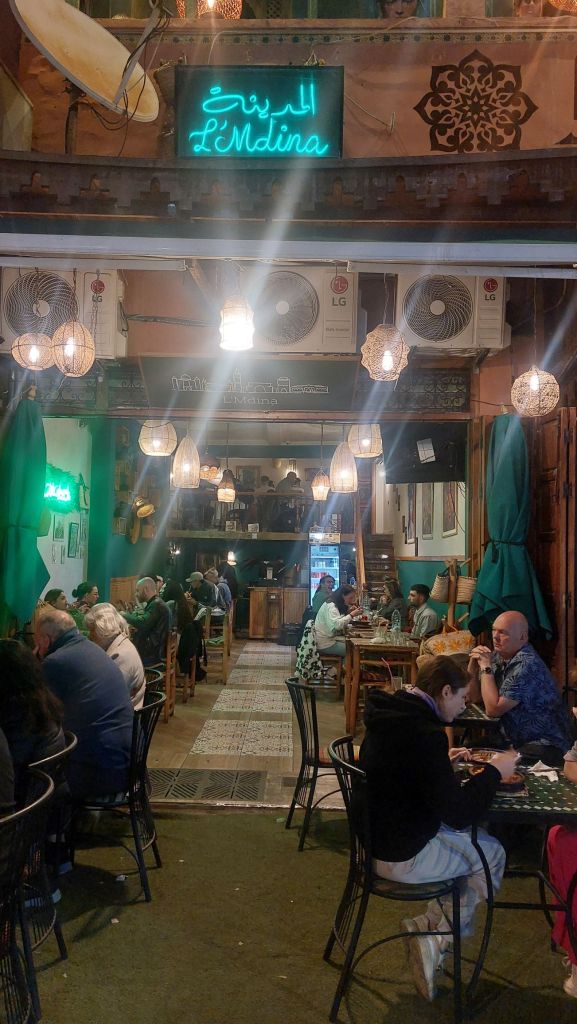
L’Mdina is a great little place serving authentic, good quality food close to Jamaa El Fna.
The meals are good value for money, and there’s a lively atmosphere with live music playing.
The menu is interesting and varied.
They serve traditional tangia (tender meat, cooked for hours in an earthenware pot, called a tangier)
The lamb was cooked to perfection, succulent and tender, and the aromatic aroma as it was tipped from the tangia onto the plate was mouthwatering.
The salads are delicious and creative, combining an interesting infusion of flavours.
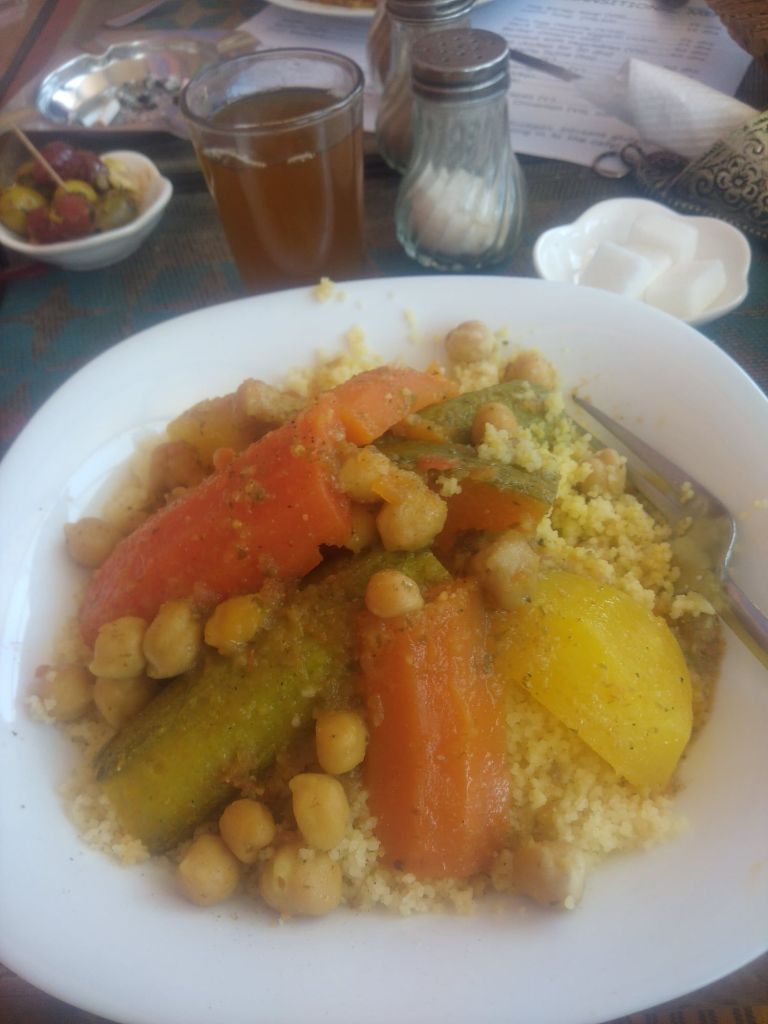
I especially enjoyed the vegetable tagine, with root vegetables and chickpeas.
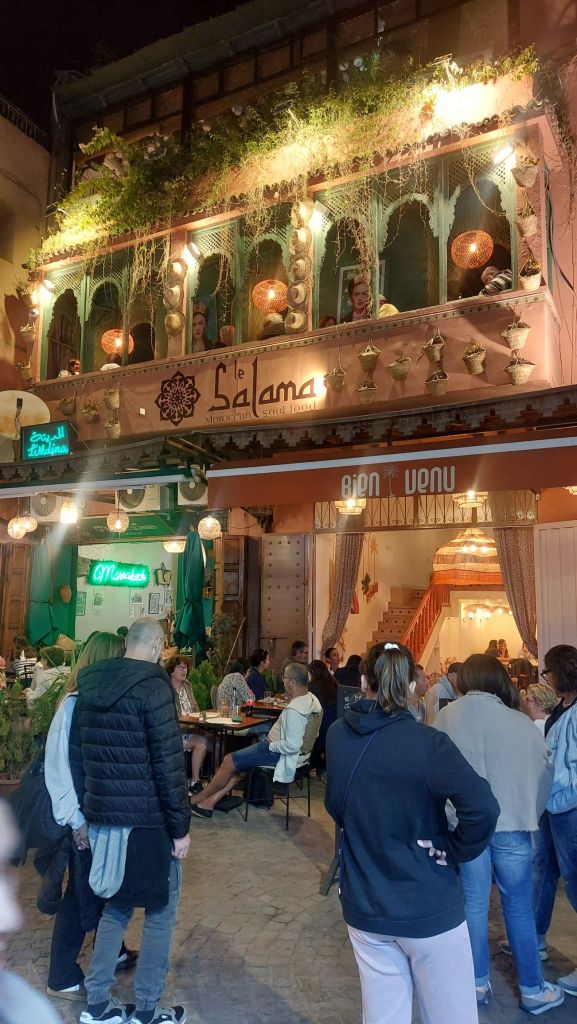
L’Mdina is a restaurant serving Moroccan, Mediterranean, and international dishes with a traditional gastronomic touch.
It is located about 2 minutes from the square.
They also have seating available for people, simply wanting a coffee or just a drink at the bar, whilst listening to some live music.
The menu is suitable for vegetarians with vegan options also available.
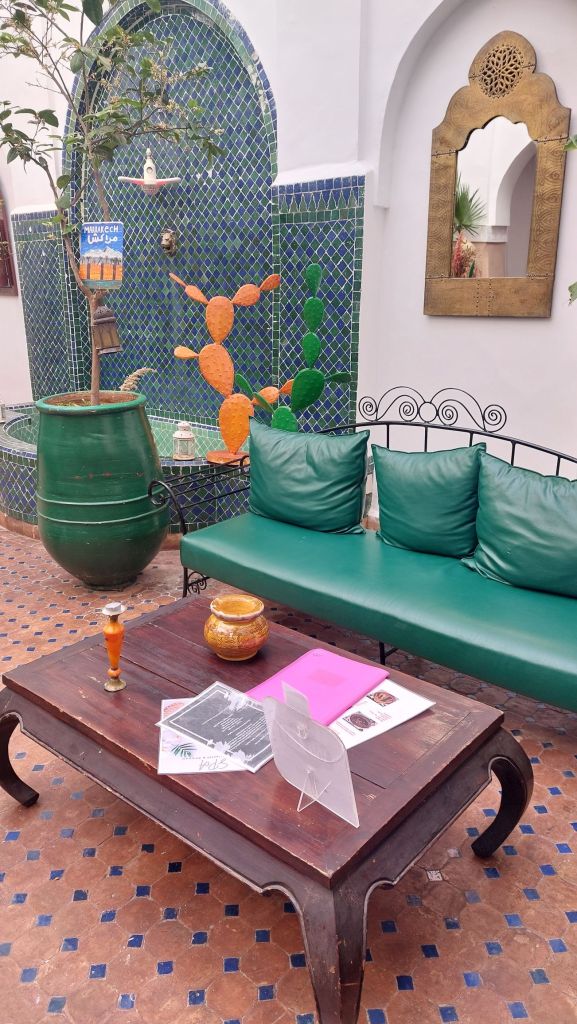
The restaurant seats 60 people and is beautifully decorated with an authentic Moroccan theme.
The musicians played a mix of traditional Morroccan music and Latin American.
They entertained the diners without being too loud, so we were able to engage in conversation.
It was the perfect dinner setting. A combination of good food, a nice ambience, as well as being budget friendly.
Whilst it can get quite busy, I didn’t have to queue long.
I was happy to be seated outside. It was a nice, warm evening, and I was content feeling the vibe of the restaurant mixed with the magic of the medina during evening time.
L’Mdina is close enough to the main square for a break from the hustle and bustle, whilst still feeling a part of it. It’s a place to go for an hour or so to recharge one’s batteries.
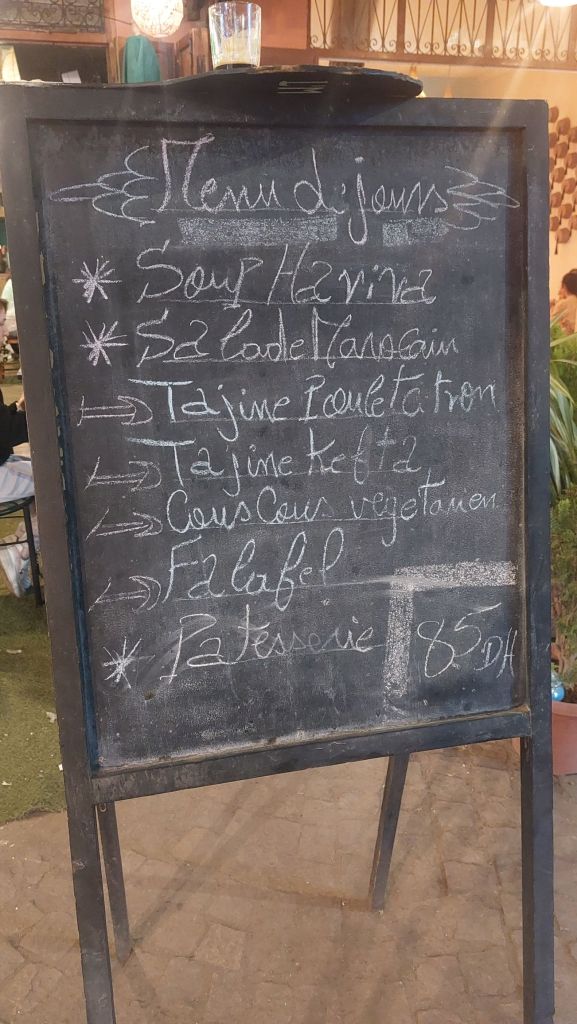
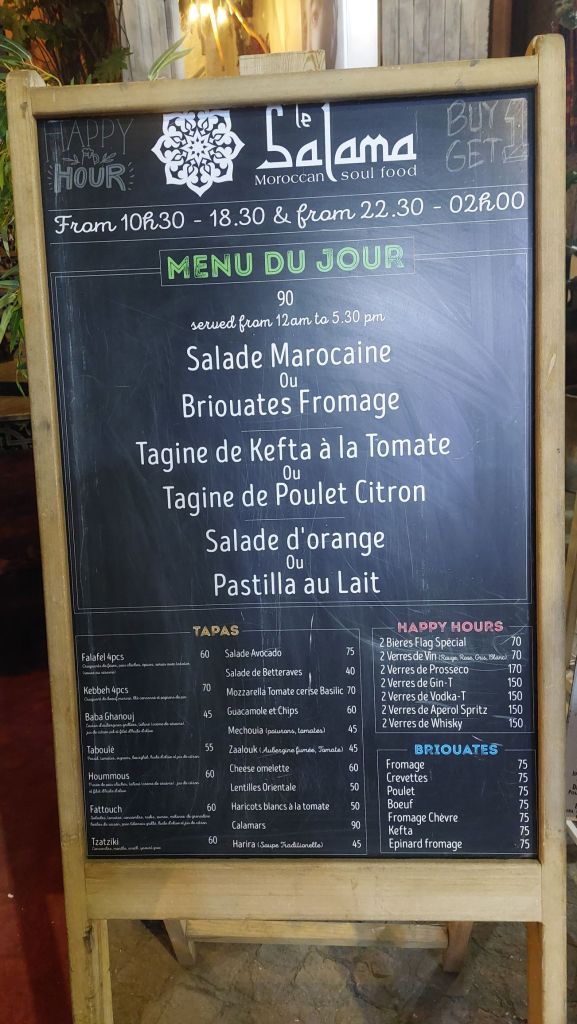
There is a set menu at lunchtime for 85 dirhams, and it’s worth every penny.
If you want a tasty meal, which is reasonably priced with some entertainment, I recommend giving L’mdina a try.
The restaurant’s address is;
42 rue des banque
Marrakech 40000
L’Mdina opens at 12 midday and closes at 23.00
They accept card payments.
For more information about places to eat, contact me via the email address below;
Riad Lea, as it is also known, is a traditional mid priced riad only 10 minutes walk away from the main square.
There are 5 suites, and they are authentic and comfortable.
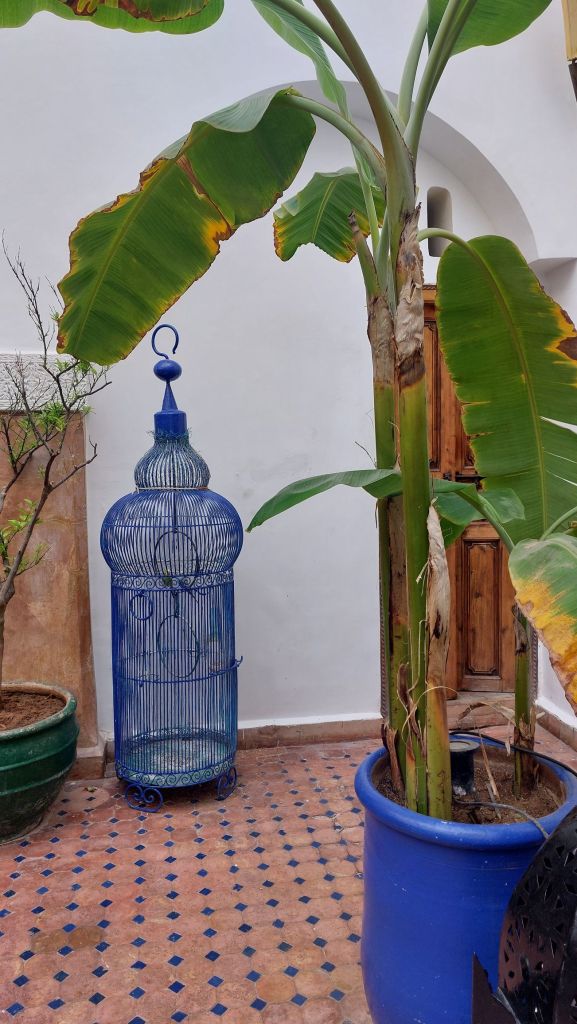
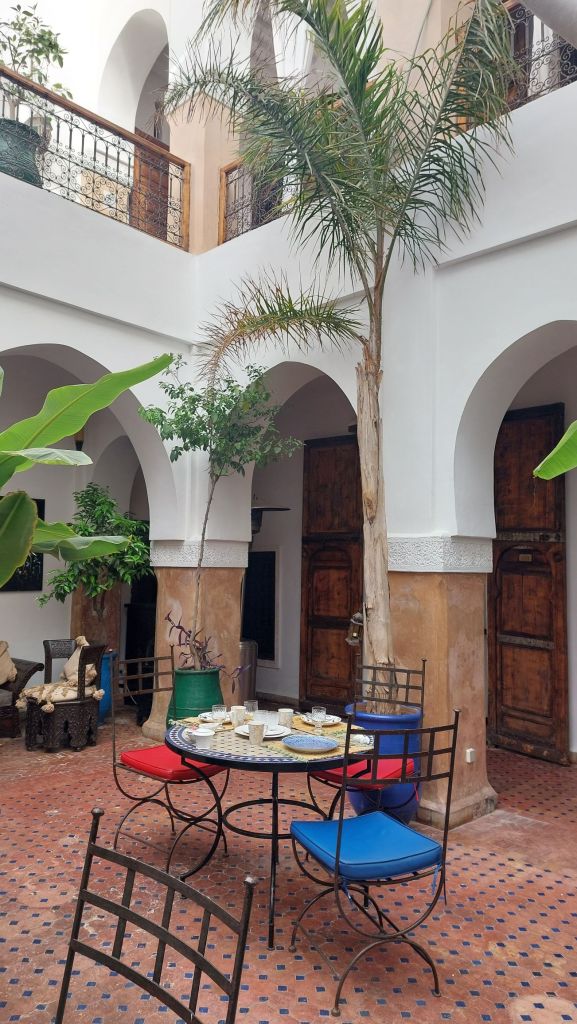
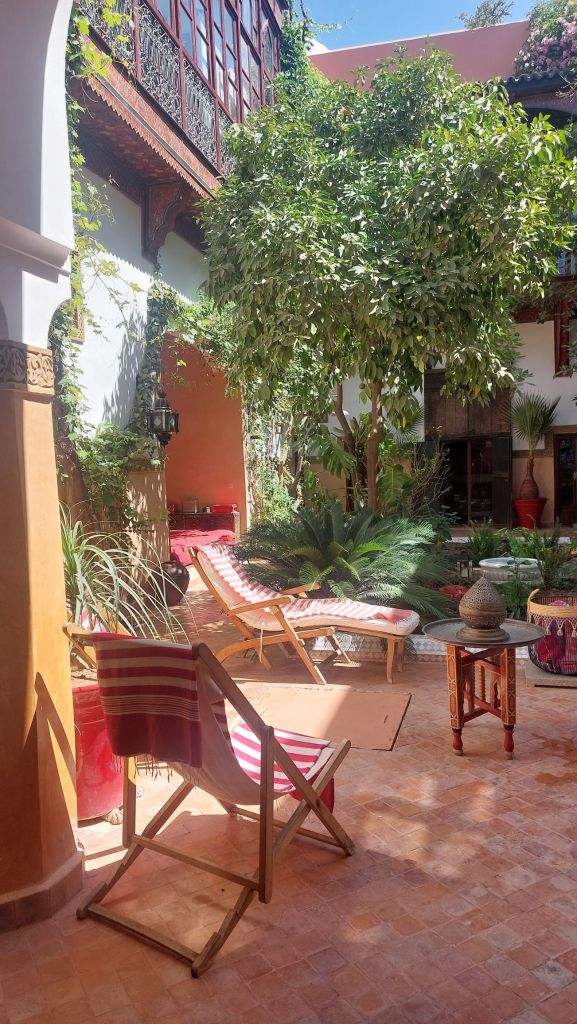
The courtyard is peaceful with the sound of birds chirping.
It’s a nice place to sit and cool down after a busy morning exploring the city in the heat.
The rooftop is a great place for a spot of sunbathing, and there is also a jacuzzi.
The staff at Riad Lea were especially attentive. They couldn’t do enough for their guests.
They even offered me some of their food they were breaking their fast with during Ramadan.
It’s the little touches like this that make a traditional riad such a charming place to stay.
While there are plusher places with modern amenities and more recently renovated riads, it’s the personal touches that stand out for me.
The staff at Riad Lea made sure that their guests felt comfortable and happy.
There was a lovely atmosphere in the riad, and everyone seemed to be having a great experience.
Reaching the riad was like heading down a hobbit hole, and the doorway was not made for tall people, but once you got used to it, you remembered to duck.
The breakfast at Riad Lea was a typical Morroccan breakfast, but as good as I’ve had in the more expensive riads.
I loved their homemade yoghurt.
The walk to the main square was enjoyable, passing by lots of interesting little shops on the way.
I enjoyed my stay at Riad Lea. It’s not a fancy 5 star accommodation, but it’s good value for money.
It was clean, I had everything I needed, and the staff were a credit to the riad.
Riad Lea can be found at,
41 Derb Sidi Bou
Amar Marrakech 40000.
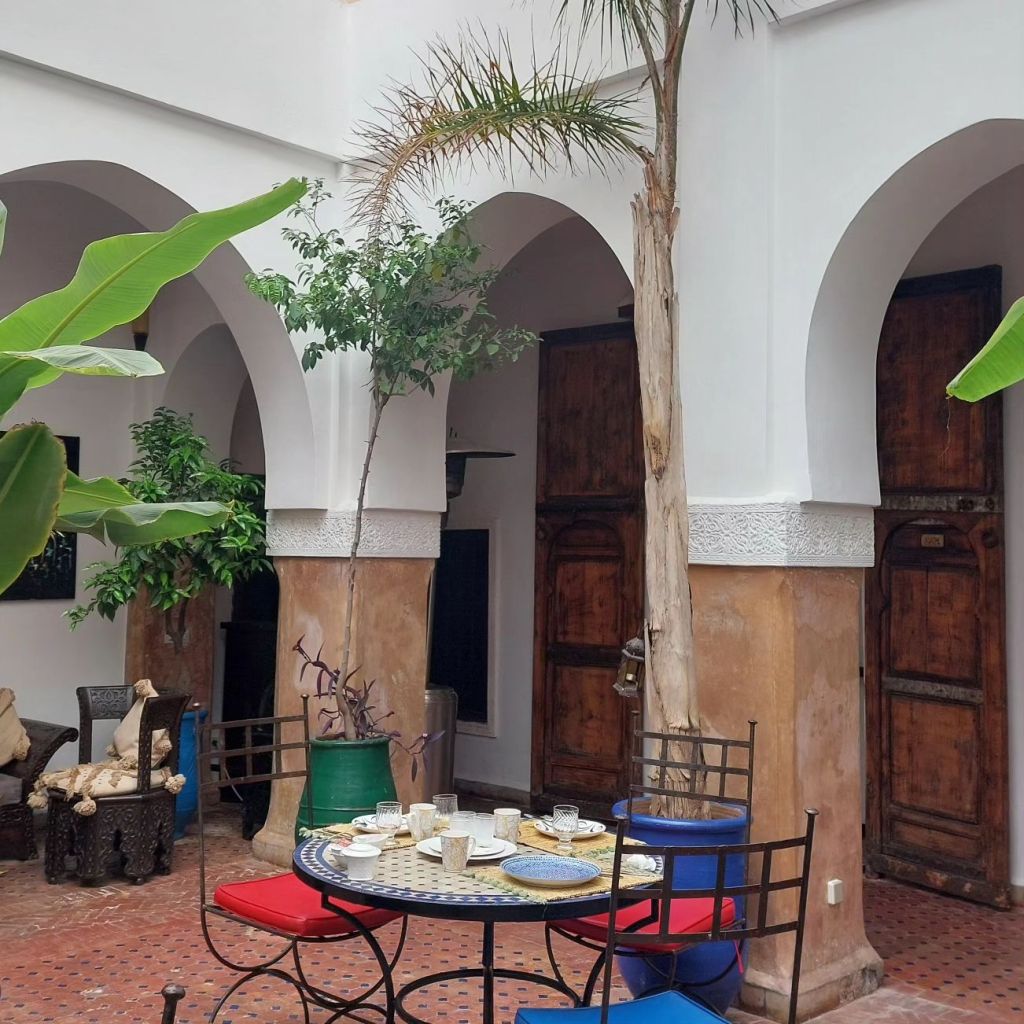
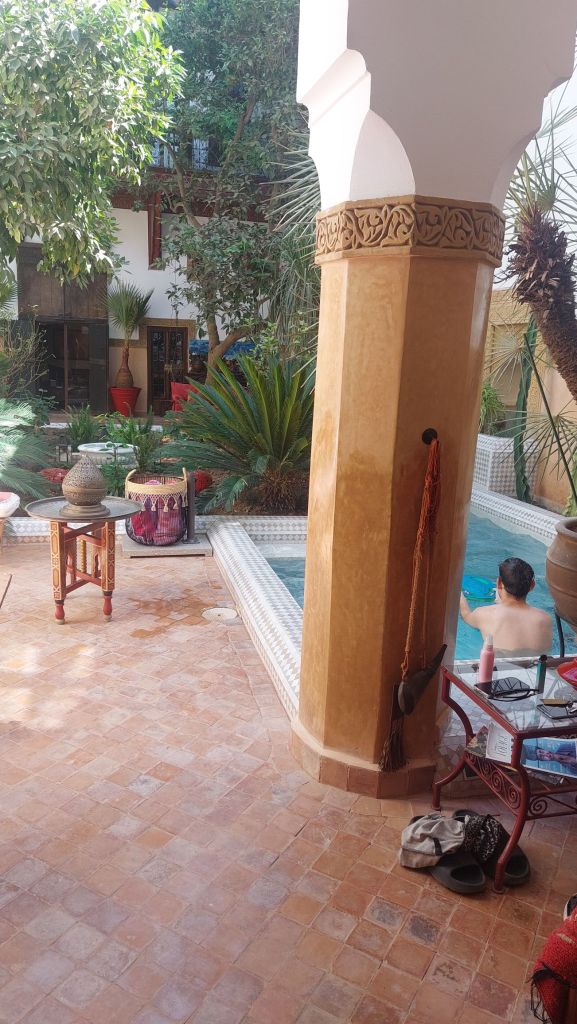
Courtyard at Riad Lea.
For more information about places to stay, contact me via the email address below;
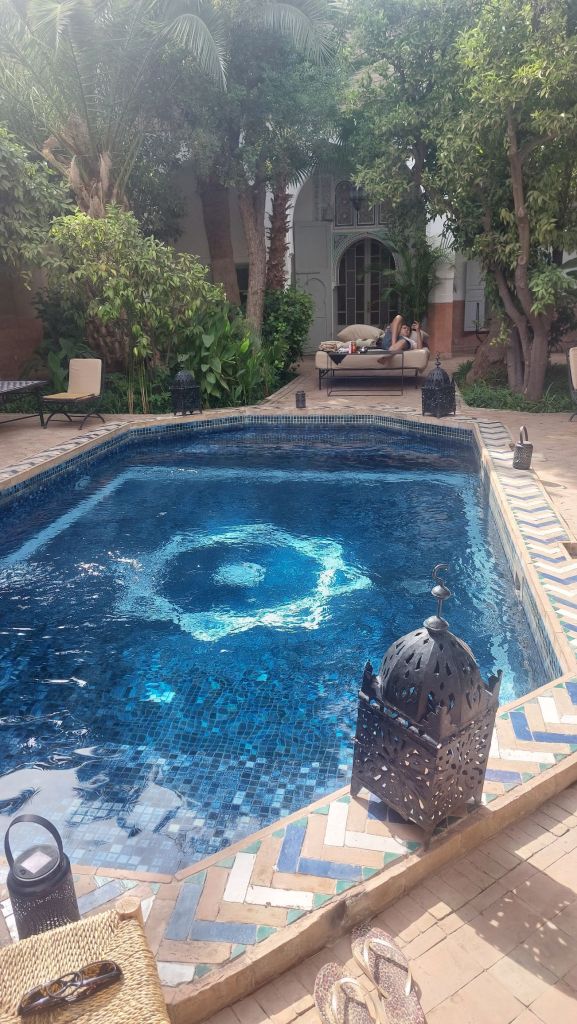
It has a tranquil courtyard with a small pool for guests to cool down in.
The pool has an exercise bike inside it.
The plants are exquisite, and listening to the birds singing amongst the foliage is so relaxing.
Every inch of riad Dombaraka is tastefully decorated with beautiful paintings and furniture. It feels as though you are staying in a royal palace.
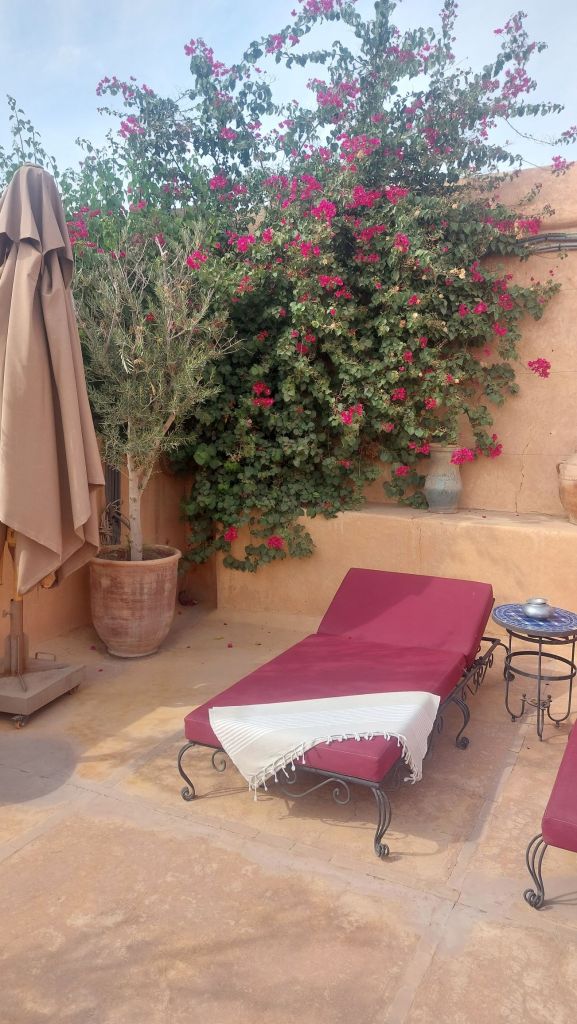
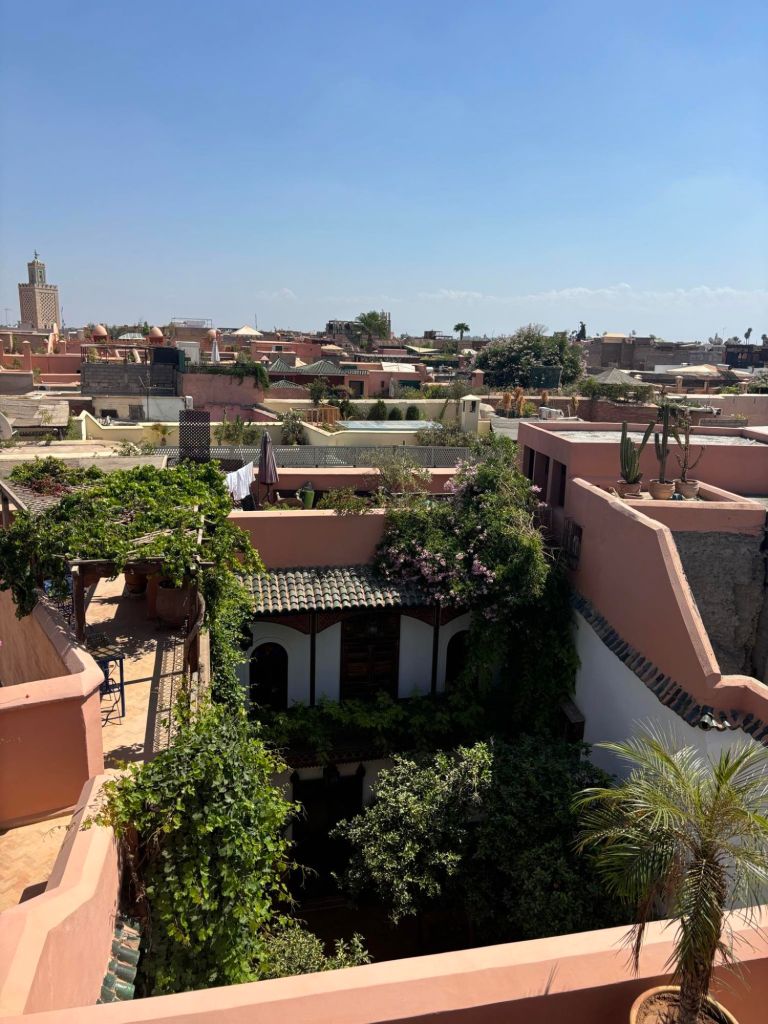
The rooftop is spacious with great views. It’s great for sunbathing with plenty of spaces to sit soaking up the hot, morroccan sun.
View from the rooftop.
There is a wonderful library with an assortment of books and fine furnishings.
The library.
The riad is kept spotlessly clean, and the staff are friendly and happy as they go about their job.
Riad Dombaraka is owned by a French woman called Dominique, who gives her guests the warmest welcome on arrival.
She suggests places to eat and visit, also arranging transport through the souks to get to them. I always felt safe and well looked after.
The breakfast was lovely. It was traditional Morroccan food with plenty of variety and very filling.
Riad Dombaraka is not particularly budget accommodation, but it is definitely good value for money.
It is an elegant riad whilst maintaining its traditional character and charm.
Guests are offered fresh water for free and asked if they would like mint tea.
Relaxing by the pool, listening to soft music and birds singing, you would never know the craziness of the Souks was literally a stones throw away outside the door.
The courtyard.
Outside the riad door, there is still evidence of the earthquake in 2023.
There are locals selling vegetables and fish, giving a true picture of morroccan life.
Inside the riad, you experience a whole different world. One of decadence and serenity.
I highly recommend Riad Dombaraka.
It is absolutely stunning, and guests are treated well.
It’s like staying in a warm, homely environment, and the food is delicious.
The address is,
47.Derb El Qadi medina. Medina Azbezt 40030
For information on places to stay or eat in Marrakech, contact me:
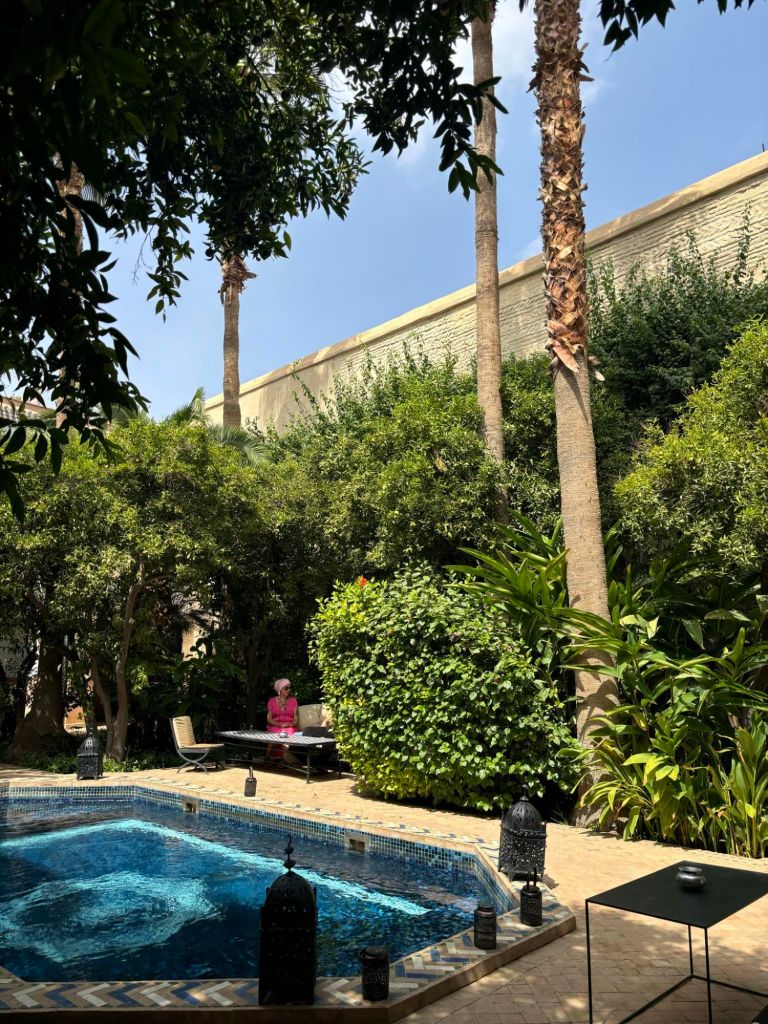
This is a large riad very close to the main square. It has a very pretty courtyard with beautiful plants and a swimming pool.
The colour of the walls are a lovely blue that works really well against the lush green foliage and tiled flooring.
The rooftop is large with plenty of seating and a warm jacuzzi. It’s lit up in the evening and looks incredibly pretty.
Views from the rooftop.
The square is visible from the rooftop, and you can hear the lively sound of everything that is going on until late at night.
I chose a room on the rooftop. It was exceptionally pretty and decorated in a Saffron colour.
Saffron room.
For light sleepers, you may find the early morning call to pray rather loud, and the noise from the square may be a bit of a problem.
The sound of the food stalls being dismantled can be heard until the early hours of the morning.
I would recommend taking ear plugs.
Riad Persephone is not a reasonably priced accommodation, and it is not a luxury riad.
It has a rustic charm, and some areas are a little bit tired and in need of a face-lift.
If you prefer a traditional style of riad, this is what you will get but at a high-end price. Don’t expect a five-star experience. You may be disappointed.
The riad offers the usual activities and has a hammam.
Riad Persephone is in a great location, close to some nice restaurants and shops.
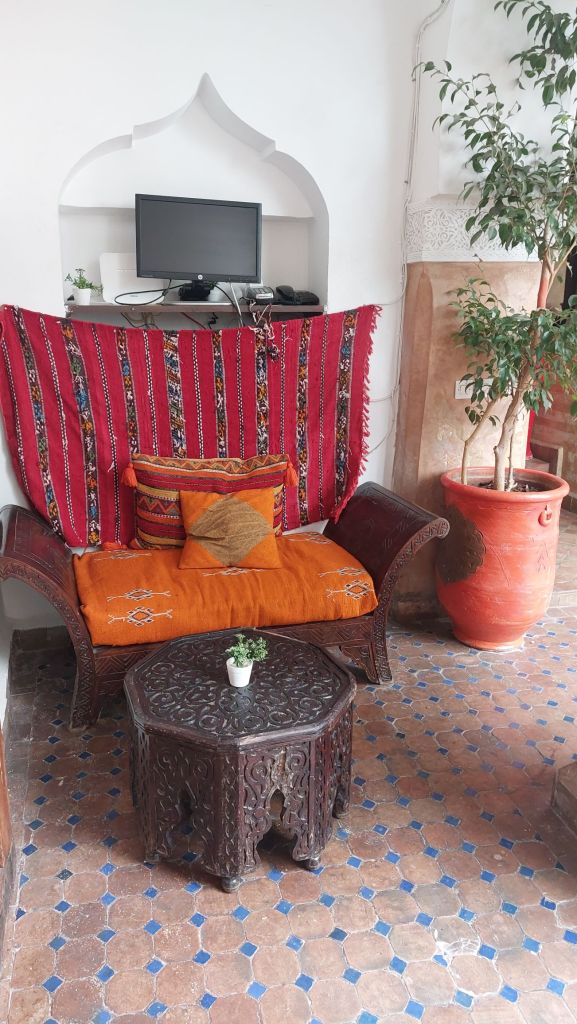
It is vibrant and colourful, with a few cosy little nooks to sit and relax.
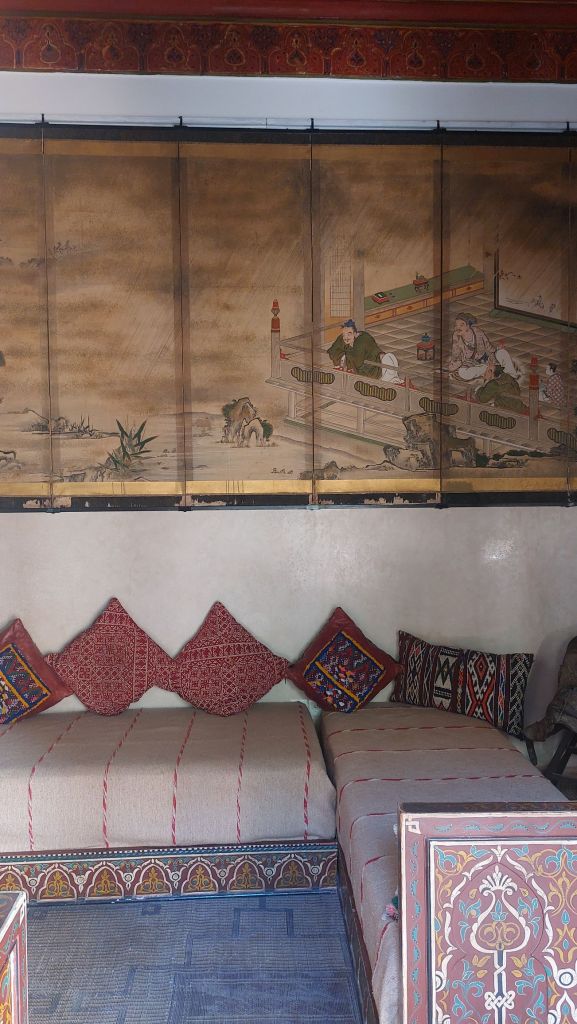
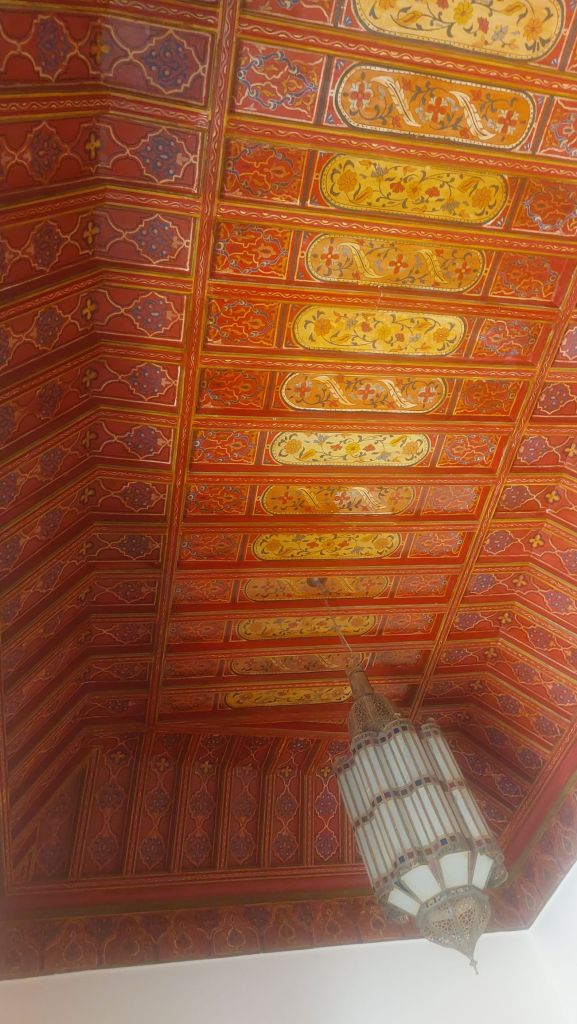
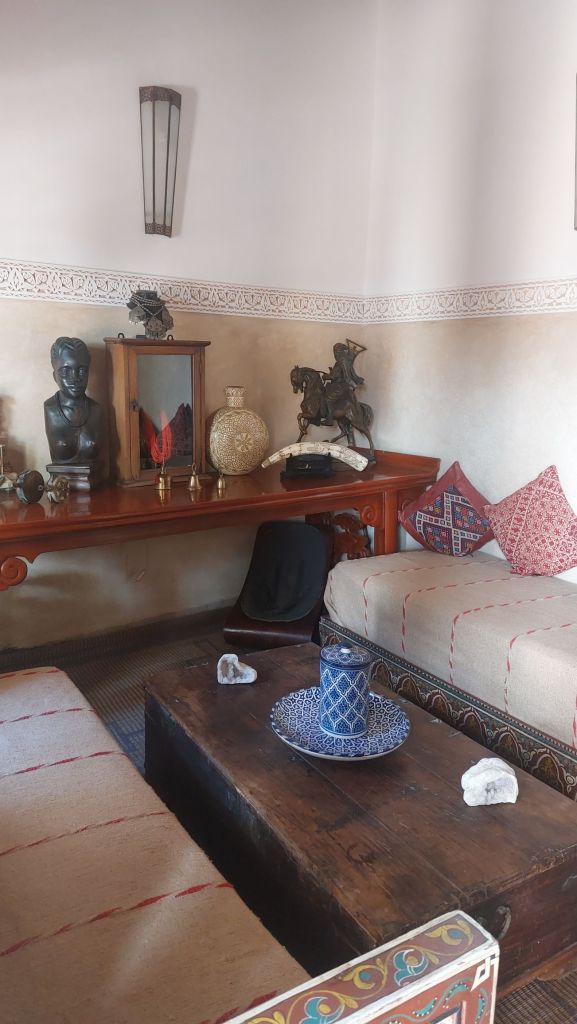
Interior of Riad Persephone.
If you’re looking for a traditional riad,there are similar riads that have excellent customer service at a more reasonable price.
At Raid Persephone, you are paying for the close proximity to the Jamma El Fna.
Overall, it is aesthetically pretty and very close to the main square.
If you are looking for a more intimate place with a friendly, homestay vibe, there are better options available.
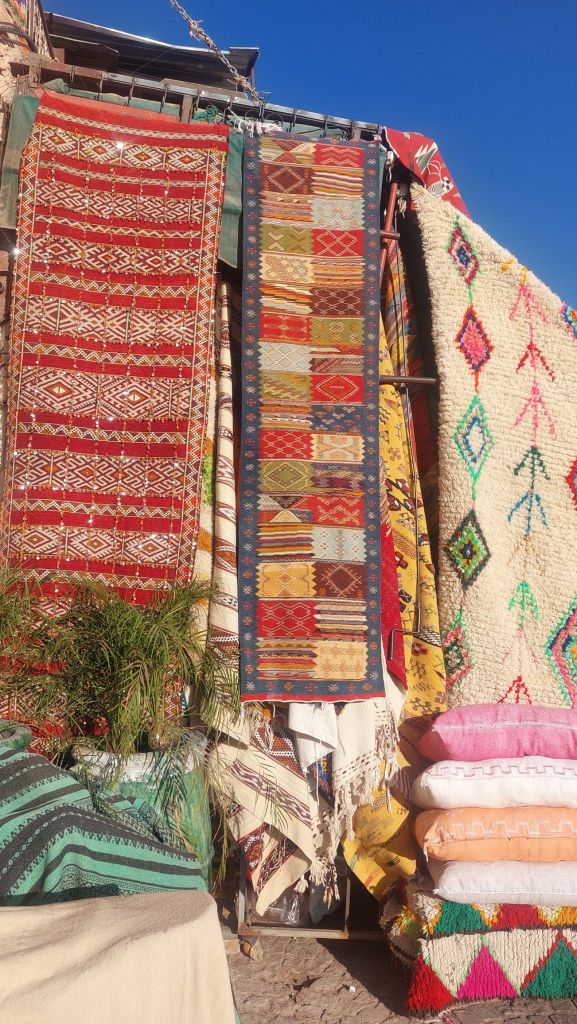
Berber rugs are handmade by the indigenous Amazigh people of Morocco.
They are made from the wool of sheep in the high Atlas Mountains.
Each type of rug tends to vary in thickness depending on which tribe has made it, so that they are suitable for the environment where they are used.
For example, Kilim Berber rugs have no pile and are relatively fine in texture.
They are handcrafted using techniques passed down through generations using natural materials renowned for their durability and luxurious feel.
Hand-knotting is a long and laborious process.
To create a single rug takes about one to two months, with four weavers working on a rug at a time.
Here are the steps taken to make a beautiful Berber rug.
1. Shearing the Sheep
Shearing the sheep is the first step in making a Berber rug. This is done by hand, using a special shearing knife. The sheep are first restrained, and then the knife is used to remove the wool from their body in one long strip. The wool is then sorted and cleaned.
It is usually the job of the men to shear the sheep, taking care not to injure them or spread infection.
The women are responsible for washing the sheared wool.
2. Carding Carding is the process of aligning the wool fibers so the weavers can spin them into yarn. To card the wool, the fibres are first combed in one direction, and then the wool is brushed in the opposite direction. This helps to loosen the fibers and align them in the same direction. Once the fibers are aligned, the weavers can then spin them into yarn. Carding is an essential step in making a Berber rug, as it helps to ensure that the rug is strong and durable. The process of carding also helps to give the rug its unique texture.
The women are often responsible for this process.
3. Spinning into Yarn
To spin the wool into yarn, Amazigh women use a drop spindle.
This simple tool consists of a shaft with a weight at the bottom. The wool is attached to the shaft, and then the shaft is twirled between the woman’s hands. As the shaft is twirled, the wool is wrapped around it, creating the yarn.
4. Weaving the Berber Rug
The weavers use a technique called continuous knotting to create intricate patterns.
This method of knotting allows the weaver to create a rug that is incredibly durable and will last many years. The process begins with the weaver tying knots in the woollen yarn.
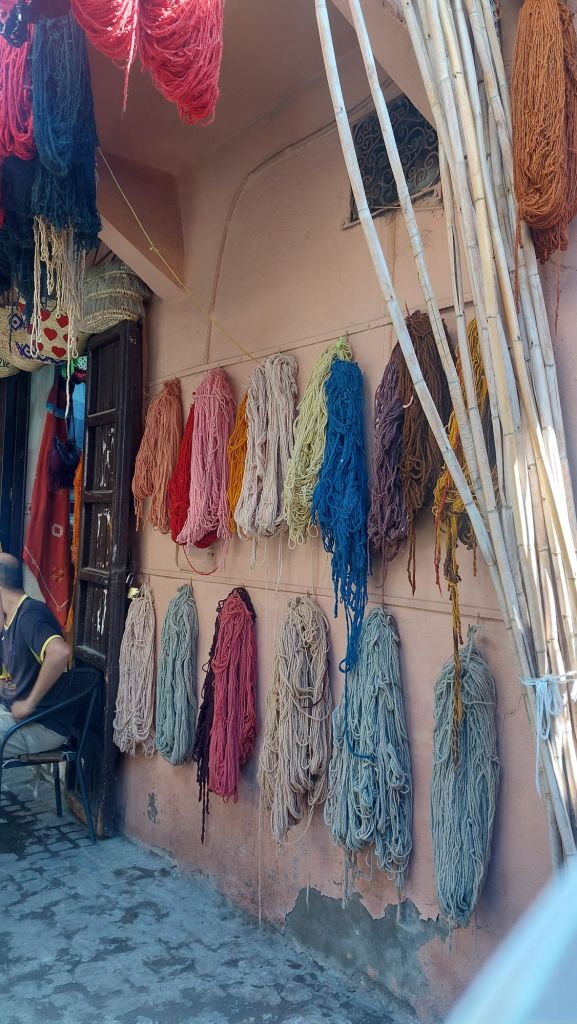
The yarn is then dyed using natural dyes from plants, spices, and fruits, which give the rugs their characteristic colours.
Once the yarn is dyed, the weaver begins weaving it into the rug using a loom.
The loom is a wooden frame that the weaver uses to create the rug’s design.
The weaver ties the yarn around the looms warp threads, which are the vertical threads that run through the loom.
The weaver then weaves the weft threads, which are the horizontal threads, over and under the warp threads.
The weaver can create various patterns by changing the direction of the weft threads.
Once the rug is complete, the weaver cuts the rug from the loom and ties the ends of the rug together. The rug is then completed.
Berber rugs are beautiful and give a home a wonderful boho vibe.
It’s important when visiting Marrakech to make sure you’re purchasing a genuine Berber rug.
There are a few scams, so be aware before you get whisked away to a shop by a friendly local.
Les Nomads de Marrakech has a great reputation and can ship rugs back home for you.
A brief glimpse into the history of the red city of Marrakech.
The magnificent Koutoubia Mosque.
Marrakech has been inhabited for over 1000 years. The first settlers were Berber farmers who had lived on the land since neolithic times.
Morocco took its name from Marrakech, the Amazigh people named the country Murakush, meaning the western kingdom. Later Arab conquerors adapted the name to Morocco.
During the 11th and 12th centuries, the Almoravids were the rulers of Marrakech, founded by Abu Bakr Ibn Umar in 1070.
They constructed an underground water system to supply water to the city canals, which attracted merchants and craftsmen to Marrakech.
They began building riads for the people who were beginning to settle in Marrakech, and it became a real city.
His cousin and successor Yuseff Ibn Tashfin developed Marrakech further, turning it into the Almoravid empire.
He erected mud brick houses, which gave the city its distinctive red colour today.
It was during this period that the Masjid al siquaya mosque was built, and souks or market places sprung up, marking the beginning of urban life in Marrakech.
In the 12th and 13th centuries, the Almohads overthrew the Almoravids and took over the city.
They continued to develop Marrakech even further, painting the walls of the city red and building spectacular palaces and the famous Koutoubia Mosque.
They were intellectuals and artists, and many scholars were attracted to the city.
They introduced education and art to the people, turning the city into a political, economical, and cultural centre.
They improved on the water system by building open air canals, allowing water to flow down from the Atlas mountains.
This gave the city dwellers a better quality of life.
The city soon began to prosper under the rule of the Almohads and became a thriving place for merchants to meet and exchange goods.
In the 13th century, the Merinid Empire took control of Marrakech in 1230 ruling for two centuries.
They built the first madrasa in 1343-9 and used Marrakech as a training ground for heirs to the throne .
Marrakech was the imperial capital of Morocco, but they much preferred the city of Fez, and so consequently, Marrakech was about to go into serious decline.
Fez became the new capital, and Marrakech became the regional capital of the South instead.
Because of this move, Marrakech was left to decay, becoming impoverished and neglected. The buildings were left to crumble, and the city that was once a bustling hive of activity began to die.
From 1578-1603, the Saadian sultans led by Ahmad Al Mansur came to power, restoring the city to its former glory and establishing Marrakech as its capital city.
They built the Saadian tombs and El Badi palace, furnishing them with intricate tile work and stucco.
Saadian tombs/image Freebird Tracey El Badi Palace/images Freebird Tracey.
They launched military campaigns against European invasion, and this period of rule became the golden age of literature and art.
The Saads built Bab Doukkala 1557-1571 mosque and Mouassine mosque 1562-72.
They also built Ben Youssef Madrasa in 1570.
Madrasa Ben Youssef/images Freebird Tracey.
In 1631, rule was passed from the Saadian dynasty to the Alaouite dynasty, which is still the name of the current Morroccan royal family.
The Alaouites promoted trade with the United States and European countries. They improved date palm crops and modernised the army.
They also attempted to take control of the Berber and Bedoin tribes.
They restored the riads and buildings in Marrakech, developing it’s infrastructure.
It was in 1911 that the capital of Morocco became Rabat.
Marrakech became a French protectorate in 1912 when the sultan Abd al-Hafid signed the treaty of Fez.
Although the sultan remained the head of state, the French had a huge influence in developing strong diplomatic and economic relations in trade and tourism.
The French began modernising the city and building new districts whilst aiming to preserve the traditional character of the city.
They encouraged tourism and exporting Moroccan dates and other produce.
In 1956, Morocco gained its independence when the treaty of Fez was passed back.
Throughout history, Marrakech has been a city that has resurged, declined, and resurged once again.
It has fought against several invasions and endured plagues and famines.
In 1982, UNESCO declared Marrakech a UNESCO world heritage site, raising awareness of the cultural heritage of the city.
It is now one of the most popular destinations in the world and receives millions of tourists each year.
Marrakech combines the ancient with modernity perfectly.
Visitors can get a glimpse into the intriguing past of Marrakech as they wander around the preserved walls of the medina.
As they venture into the tree lined avenues of Mohammed V avenue, they are presented with a newer,modern side of Marrakech, a thriving hub of fancy restaurants, bars and boutiques.
Marrakech has an astonishing history, which makes it all the more fascinating. It is well worth taking a tour of the historic buildings in the medina to get a taste of the red city’s intriguing past..
Gueliz area in Marrakech/images Freebird Tracey.
For further information or advice on planning the perfect itinerary, get in touch using the contact details below..