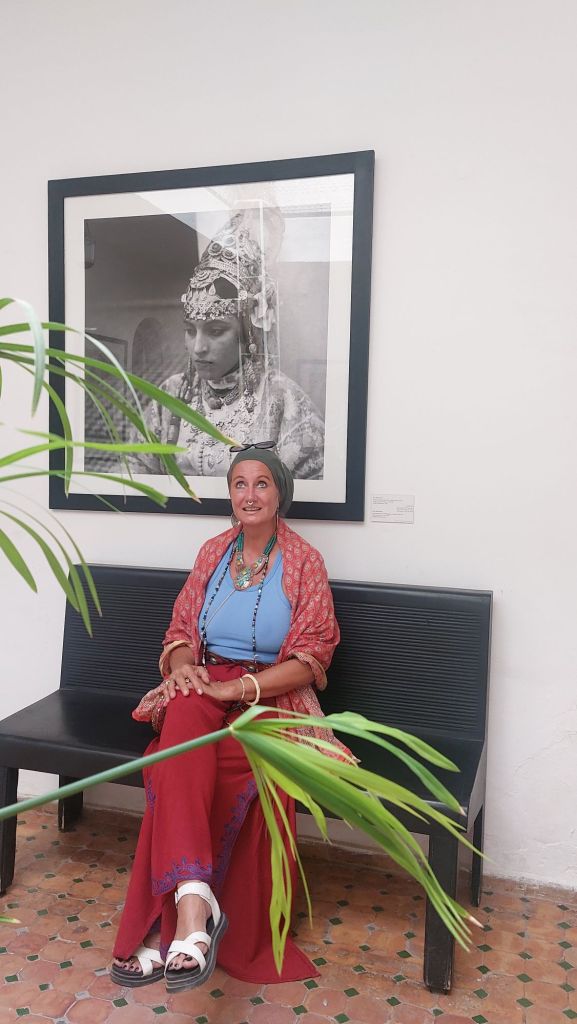
The House of Photography is an important cultural venue in Marrakech. Housed in an old fondouk in the medina, a visit here is a fascinating journey through time.
It was established by Patrick Manac’h and Hamid Mergani as a place where old photos taken in Morocco could be displayed for the public to view. It opened its doors to the public in 2009 and is now home to thousands of original documents, photographs, postcards, newspapers, and photographic glass plates.
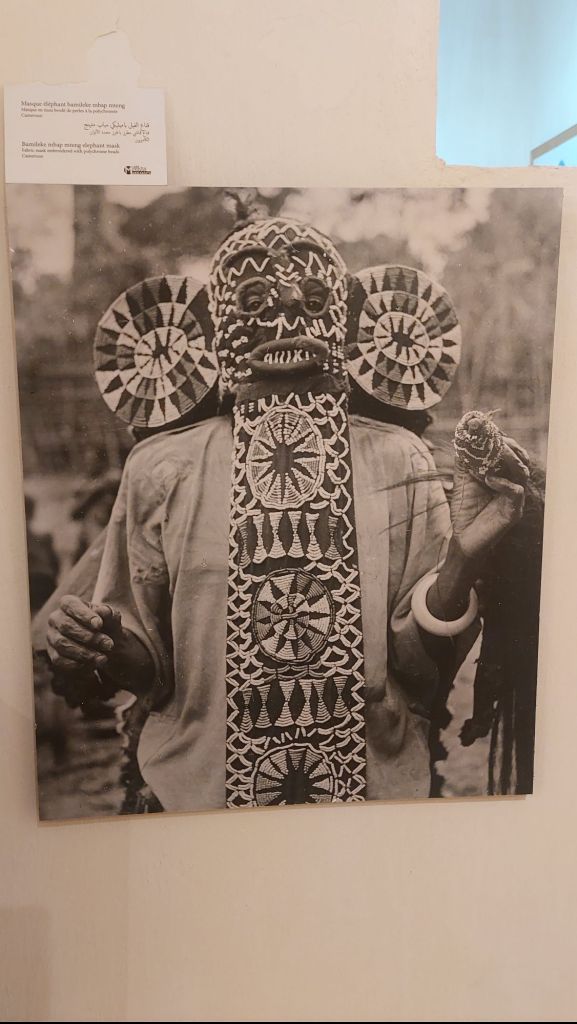
A private collection of 10,000 exhibits from 1879-1960, including contemporary photos from the present, allows visitors an opportunity to get to know the history of the Berber tribes in the high Atlas Mountains.
Image by Freebird Tracey.
The first colour film recorded in the High Atlas Mountains in 1957, called ‘Landscapes and Faces of the High Atlas Mountains’ by Daniel Chicault, is also available for visitors to watch.
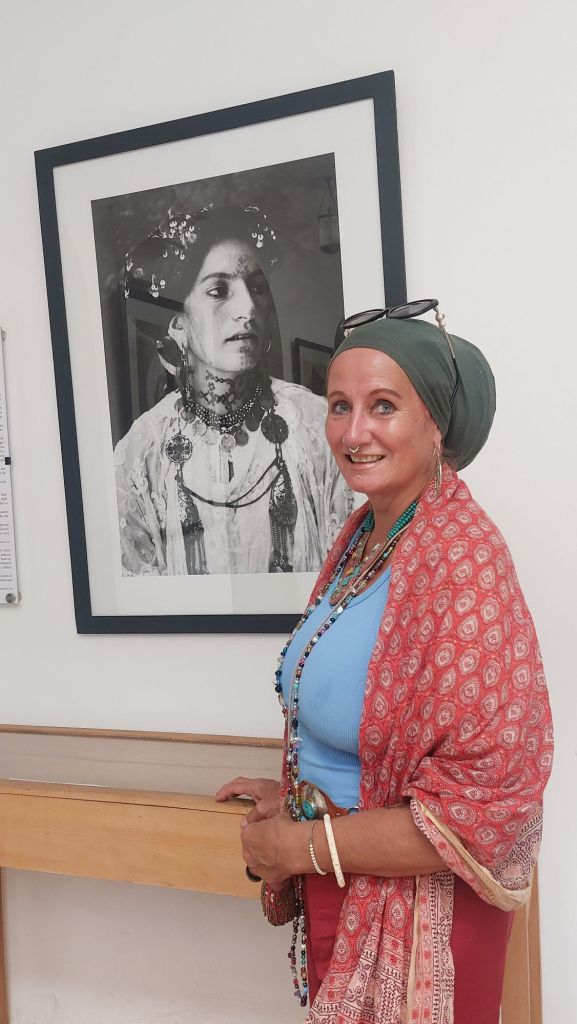
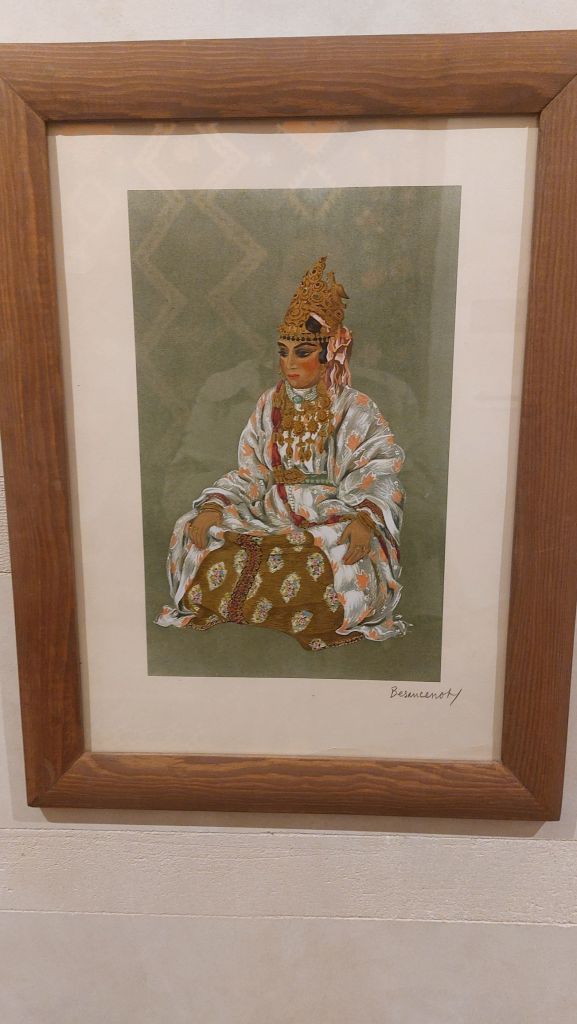
The Museum of Photography is incredibly interesting, and the photos on display are well preserved, giving visitors to Marrakech a detailed account of how Berbers lived. I was fascinated by how the women dressed and their incredible hairstyles. Watching the video has broadened my knowledge about the history of Berber culture and their customs. It’s only as recent as the 1950s, yet they survived without electricity or medical care.
The displays stay interesting because they changed them periodically, and at the time I visited, there was one about Berber Jews.
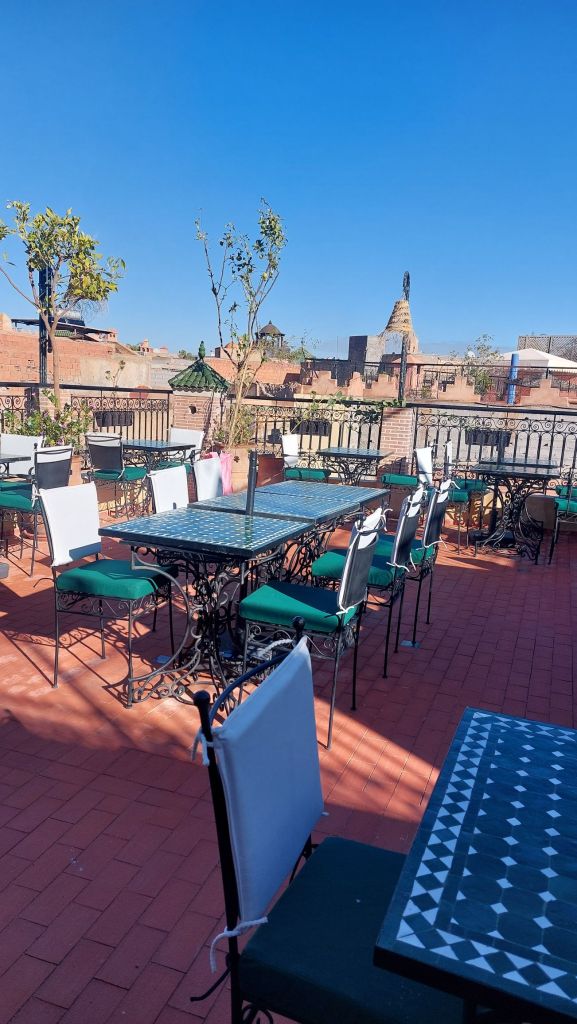
Inside the museum, there is a rooftop cafe serving drinks, including speciality coffee and food. There are views across the rooftops of the medina, and you can see the Atlas mountains in the distance. It can get pretty busy during the lunchtime rush.
You can purchase copies of some of the photographs in the entrance, and the quality of the prints is good. I bought a copy of Un Charmeur de Serpents – vers 1920, and it looks great in a vintage photo frame.
The museum is open daily from 9.00 am until 7.00pm.
The address is 46 rue Ahl Fes, Bin Lafnadek Marrakech 400030, not far from Ben Youssef Madrasa.
Payment is on entry only, and it’s 80 dirhams for adults, 15 years old and under are free. The ticket also permits entry into the museum of music.
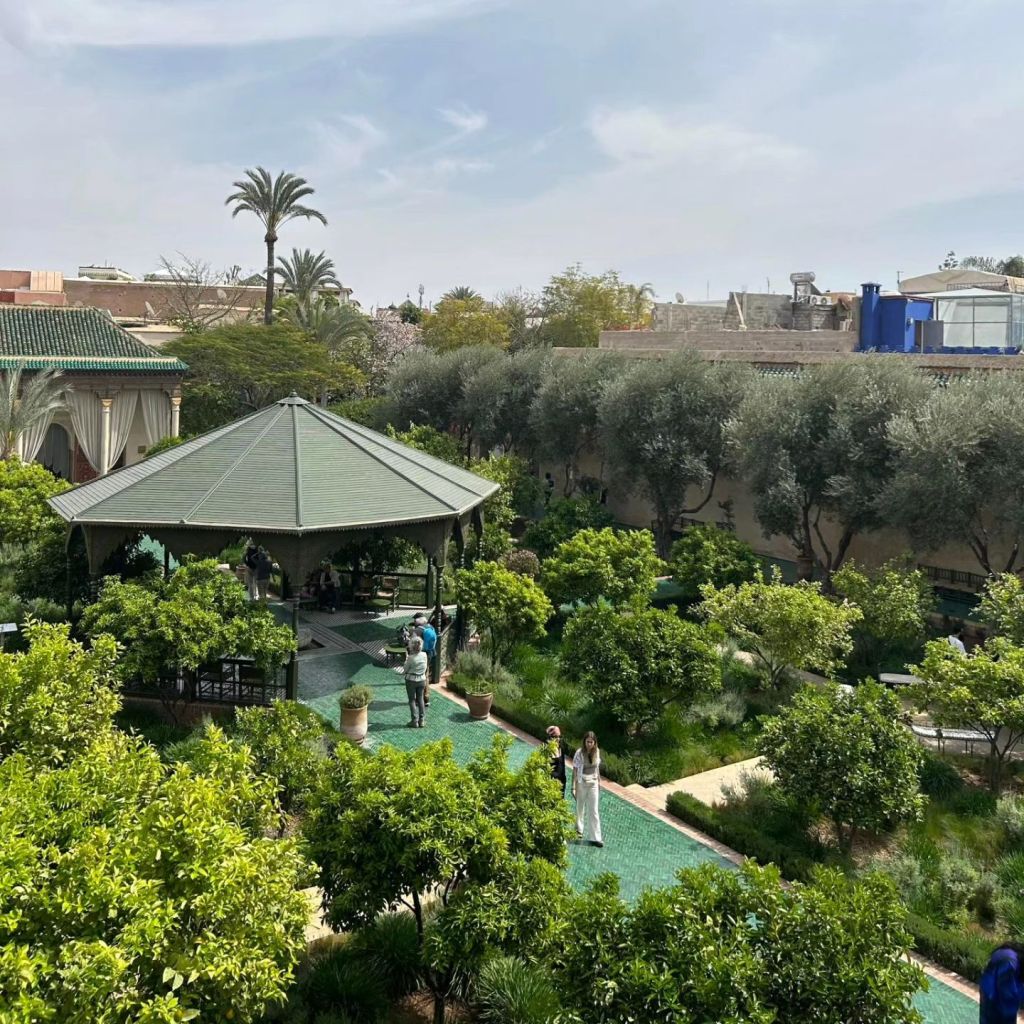
Le Jardin Secret is a hidden gem inside the medina. It’s a restored 19th-century palace complex in the Mouassine district of Marrakech. An oasis of exotic plants and flowers where you can sit and enjoy the calm and beautiful surroundings, listening to the birds singing in the trees. Nestled secretly in the middle of the souks amidst the chaos, suddenly appears this quiet, enchanting space to spend a little time recharging your batteries.
In the heart of this magical oasis, there is a decorative pagoda to sit in the shade and recollect your thoughts.
Image by Freebird Tracey.
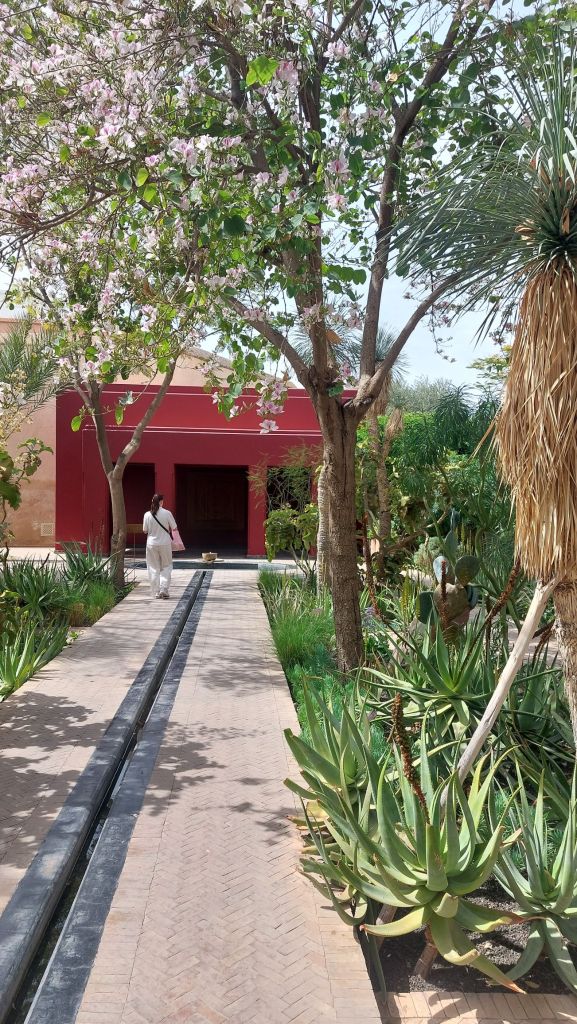
Le Jardin Secret boasts two attractive large gardens. One containing a range of plants from around the world, the other a traditional geometric Islamic garden. It also has one of the highest towers in the medina with panoramic views.
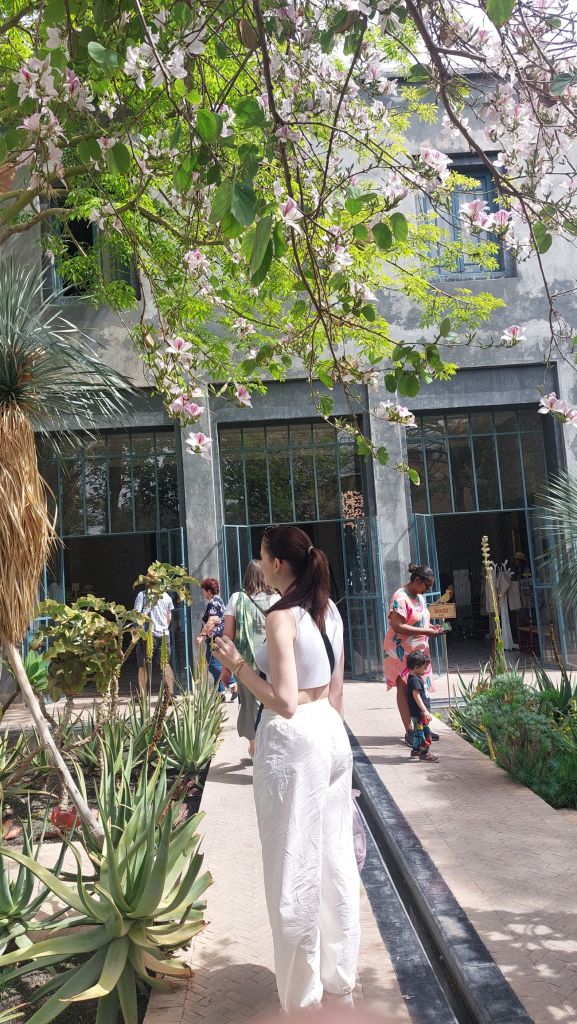
There is also a museum, a boutique, and two coffee shops on site if you want to enjoy a drink or a few light refreshments sitting in the sunshine.
Image by Freebird Tracey.
Le Jardin Secret dates back 400 years ago to the Saadian dynasty and was left to decay before being discovered and renovated in the nineteenth century. It is a prime example of the beauty of Islamic art and architecture, and you can find out more about its history inside the museum.
Images by Freebird Tracey.
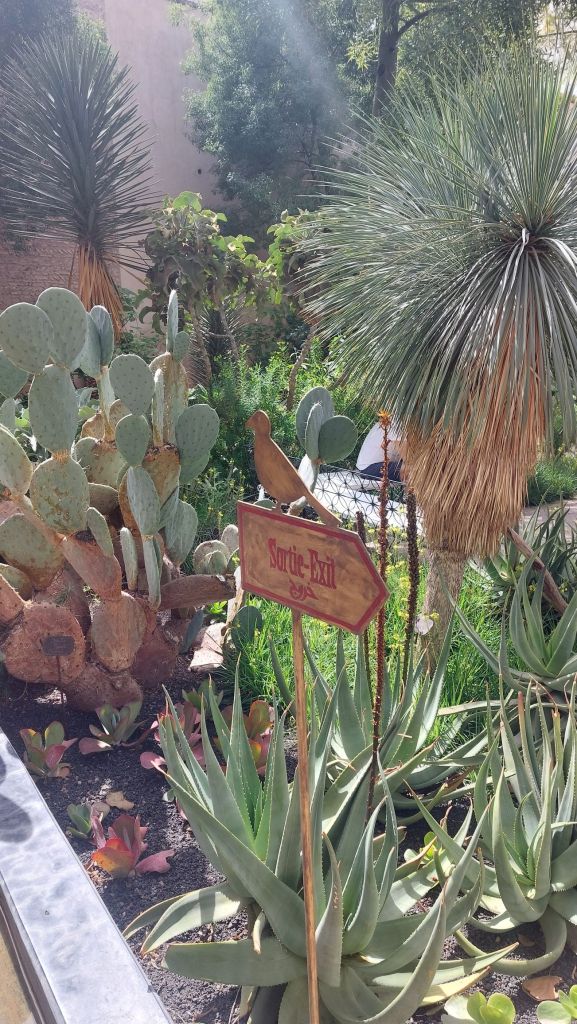
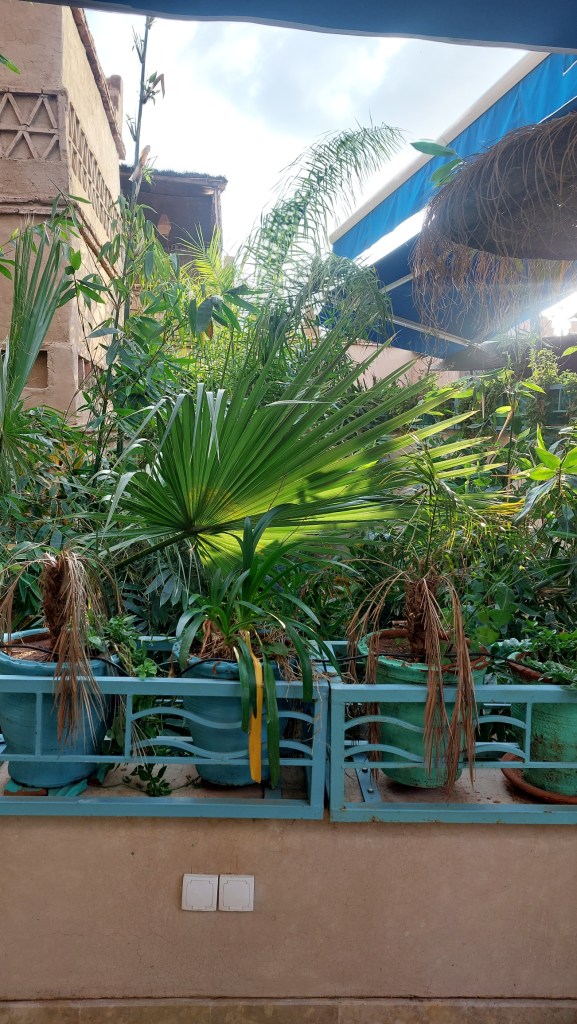
The gardens are simply beautiful with Cacti, palm trees, and other exotic plants, flowers, and shrubs. There is a small pond with resident toads and turtles who sit basking on the rocks to the delight of passing tourists. The harmonious sound of birdsong allows you to feel like you’re a world away from the busy souks outside the walls.
Image by Freebird Tracey.
There are plenty of benches dotted around the gardens for you to sit and enjoy the tranquillity and beauty that surrounds you, sitting here peacefully, you forget you are still inside the busy medina, dodging motorcycles, tourists, and donkeys.
Image by Freebird Tracey.
To get the most peaceful experience from your visit to Le Jardin Secret, I suggest arriving early in the daytime before the gardens become too busy with other tourists.
Le Jardin Secret is located at 121 Rue Mouassine Marrakech 40030 Morocco. Opening times may vary depending on the time of year.It costs 100 dirhams to enter, and the gardens are wheelchair user-friendly.
The cafes serve sandwiches, pizzas, and salads. They also offer hot and cold beverages, including juice, smoothies, tea, coffee, and a selection of delicious homemade cakes.
Marrakech Museum has a calmer atmosphere than other tourist attractions.
It is undoubtedly one of the most beautiful museums I have ever seen. Literally, next door to Ben youssef Madrasa, it’s in a perfect location for combining both sightseeing attractions.
I had mixed feelings about visiting after reading reviews, suggesting there wasn’t much to see. I was so glad that I did. It was really beautiful inside and held a lot of information about the Amazigh culture and the history of Marrakech.
The museum was once Dar Mnebhi Palace, constructed at the beginning of the 20th century by Mehdi al-Mnebhi. It was renovated by the Omar Benjelloun Foundation and became a museum in 1997.
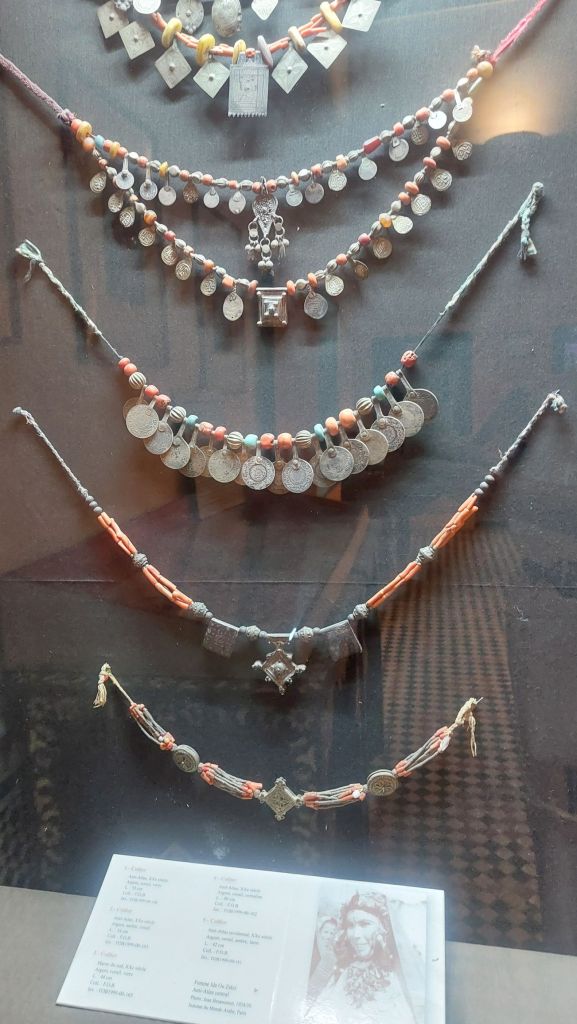
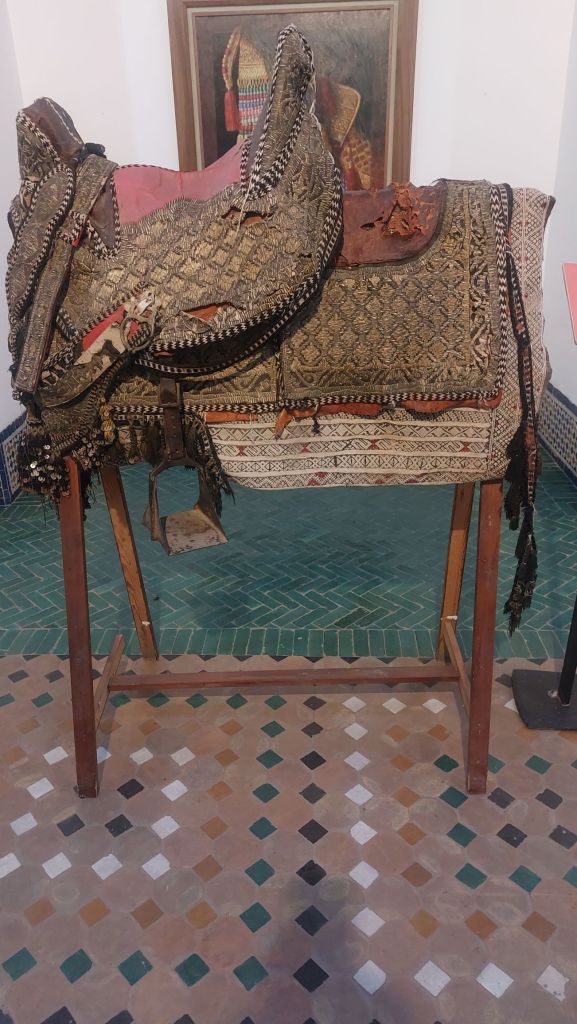
It now houses a selection of art objects, including Berber jewellery, weapons, carpets, costumes, and pottery from Fes. There is also a variety of modern contemporary art that changes regularly to keep it exciting. Regular events and exhibitions are also held here.
Images by Freebird Tracey.
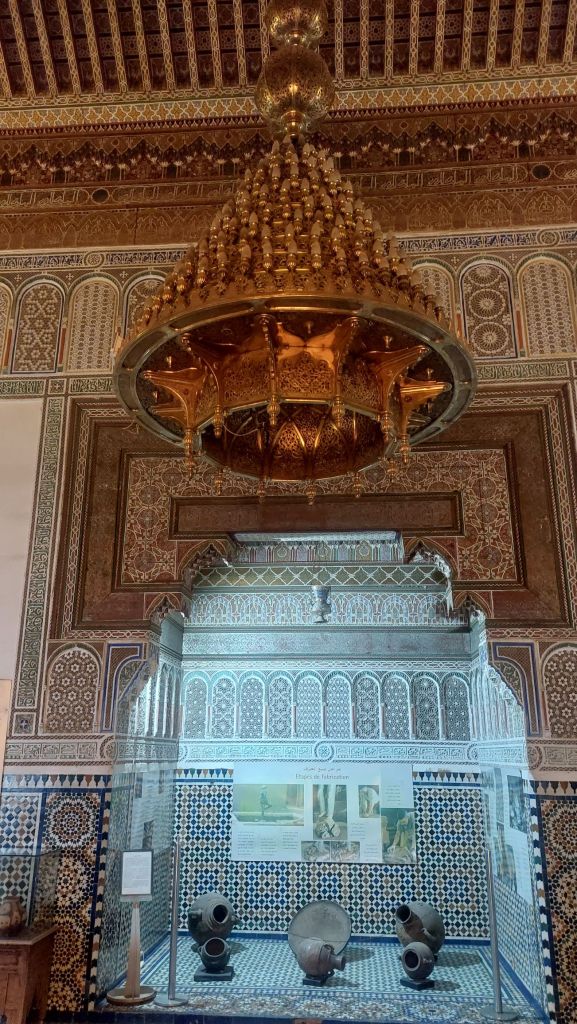
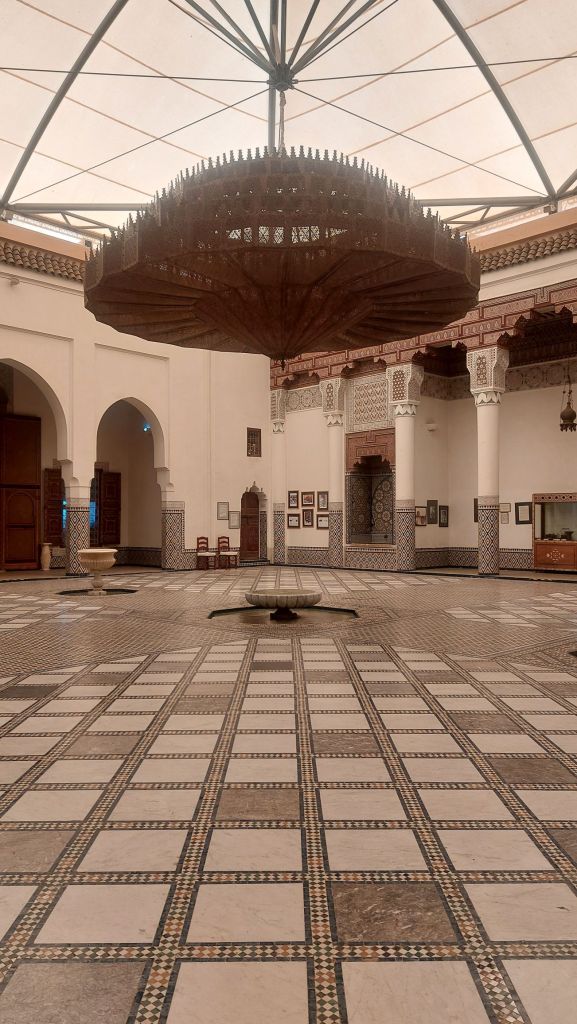
The architecture is stunning with a large courtyard containing a huge central chandelier made up of brass pieces cut into ornate geometric and arabesque motifs.
Images by Freebird Tracey.
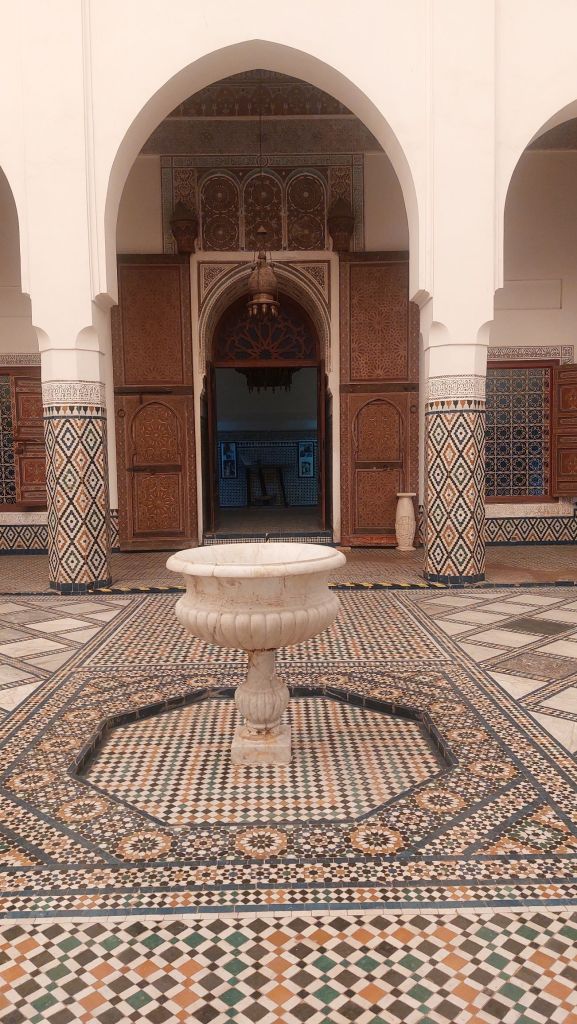
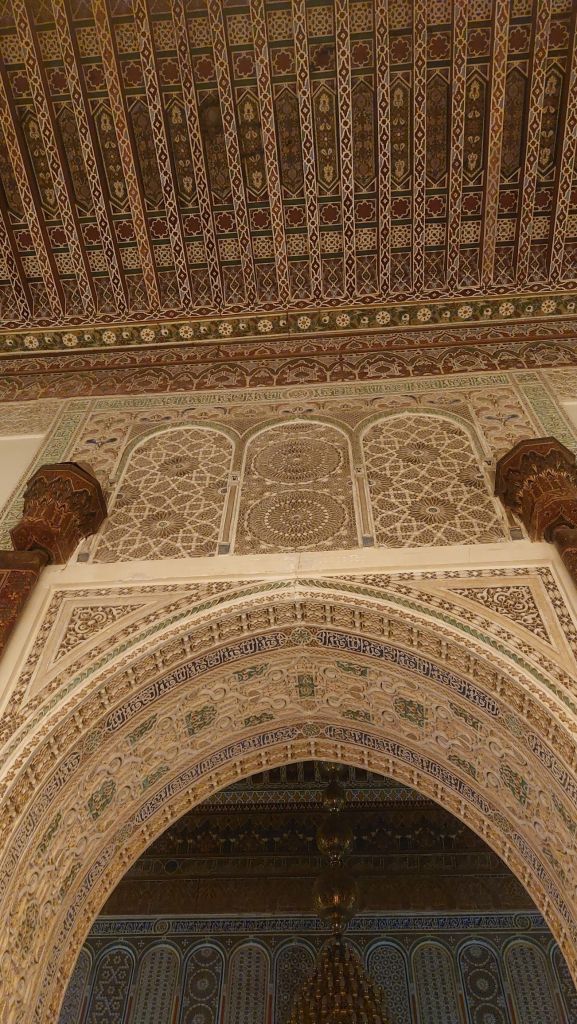
There are fountains with beautiful coloured zellige tiles and rooms that branch off with ornate cedar wood and stucco decoration. There is also a centuries old hammam.
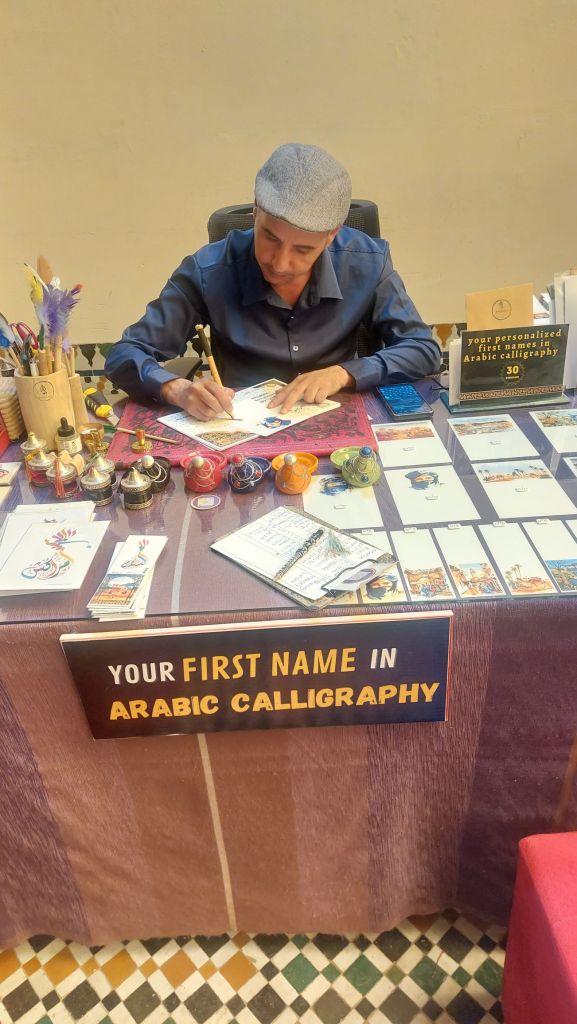
In one corner of the courtyard sits a calligrapher who can write your name in Arabic on a postcard. If you want this as a gift, get him to scribe it before you begin looking around the museum as it takes a little while to dry.
Image by Freebird Tracey.
Outside is a large open courtyard with a cafe where you can have drinks and light snacks. There’s also a small shop selling good quality prints, postcards and other interesting stuff.
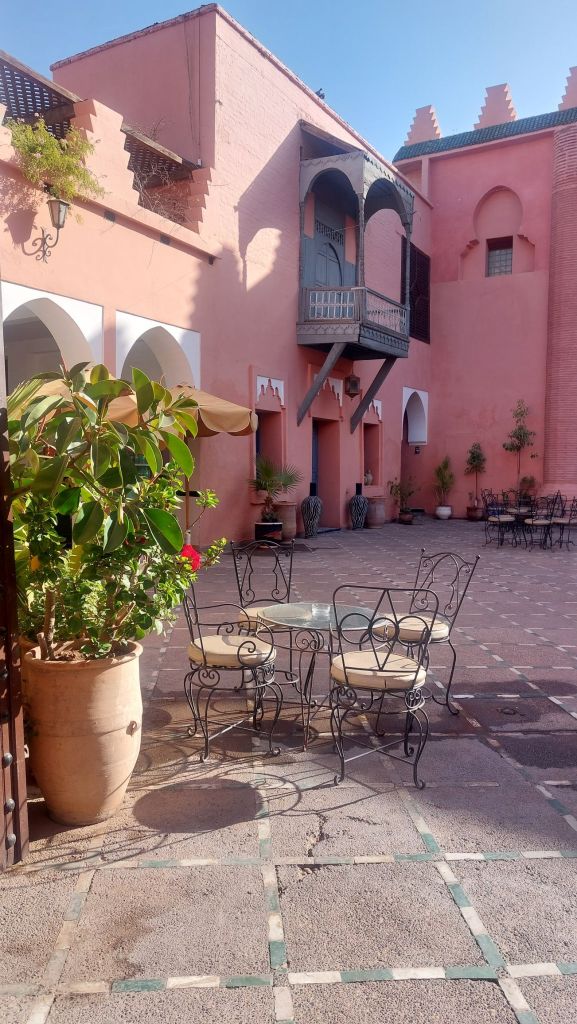
I really enjoyed the Marrakech museum. The architecture was beautiful, and I found it more low-key and less crowded than some of the other attractions around Marrakech. I liked the structure of the building from the outside and the typical red coloured clay that glows in different hues in the sunlight.
I would recommend stopping by to explore some of the exhibits in the Marrakech Museum after visiting Ben Youssef Madrasa.There is no cafe within the Madrasa, so it’s a great place to stop and take a break from the heaving number of tourists and spend some time in a calmer environment.
The Marrakech Museum is located at J2H6+VPJ, Place Ben Youssef, Marrakech 40000, and opening hours are 9.30am-6.00pm daily.
There’s a small entry fee of approximately 50 dirhams.
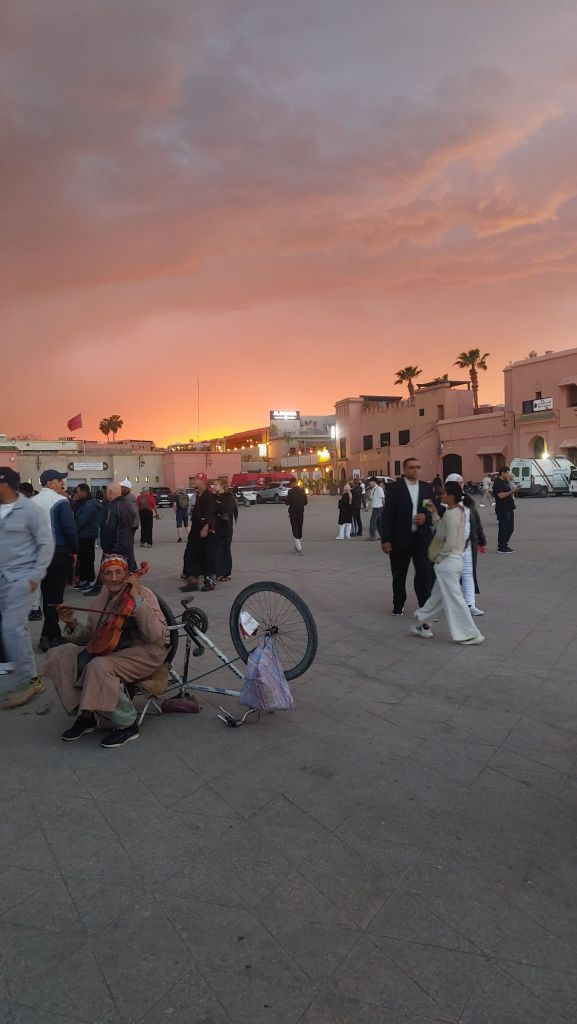
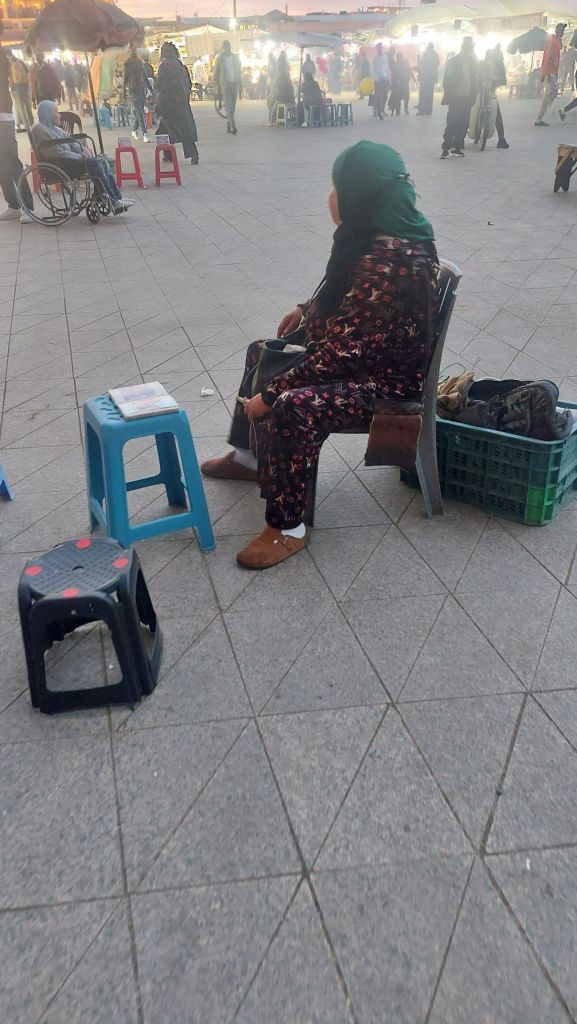
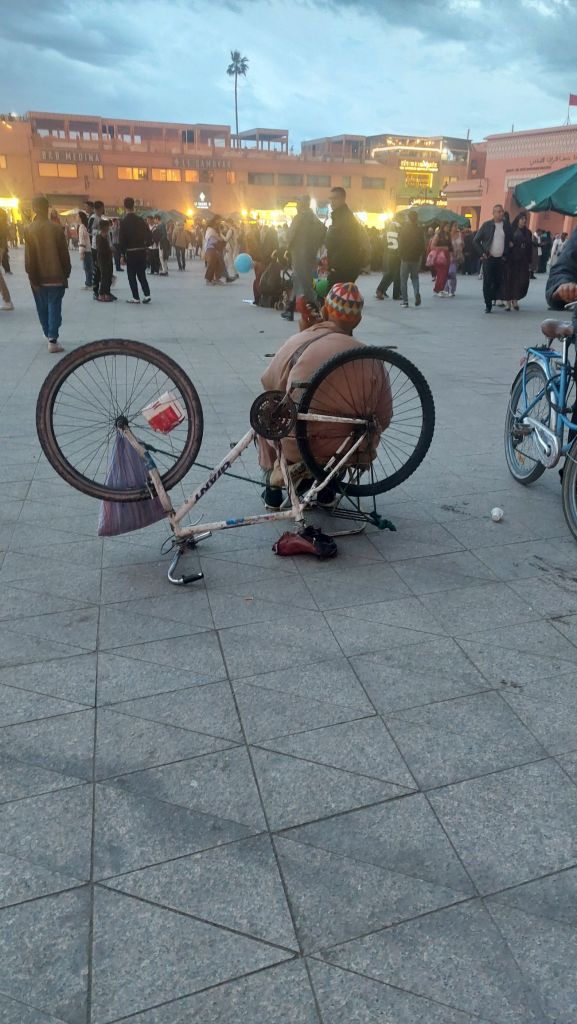
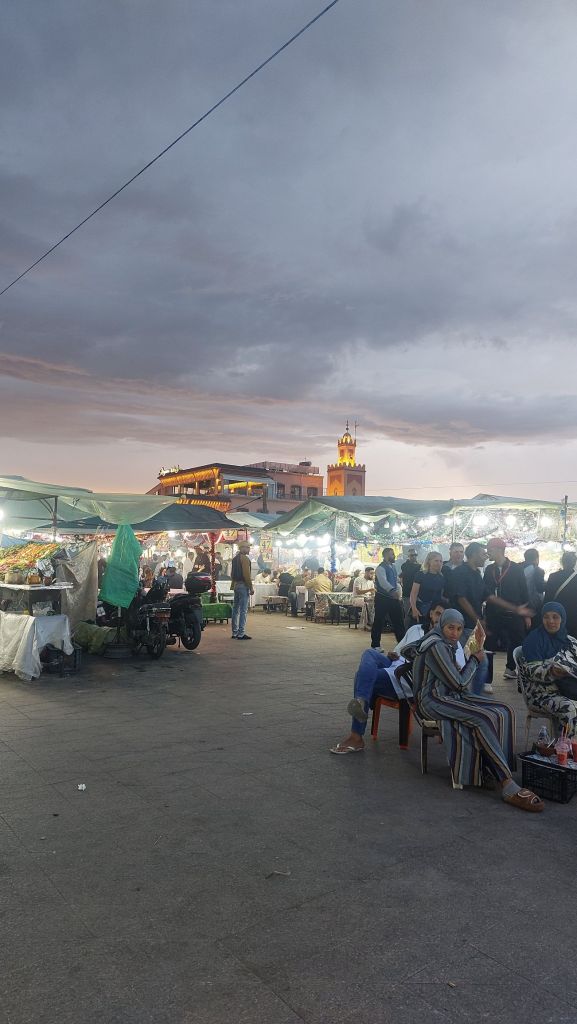
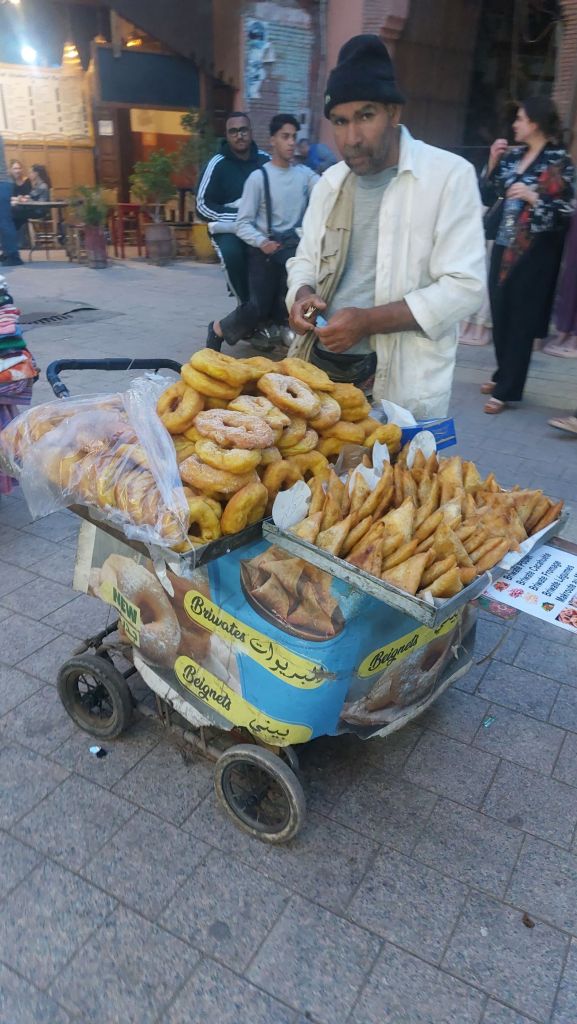
If you think that Jamaa El Fna is a busy place during the daytime, be prepared for a surprise once the sun begins to set. Gone are the snake charmers and monkeys on chains, to be replaced by open-air restaurants, gnawa musicians, gambling, and exotic dancers.
Images by Freebird Tracey.
The scene is organised chaos and a complete sensory overload. The sights, sounds, and smells are not for the faint-hearted. The drumming becomes intense as the main square takes on the image of a huge fair ground.
Thousands of people from all over the city and beyond come together to meet each other, alongside tourists all vying for space to watch the spectacle unfold. The exciting atmosphere is electric and pulsates with energy.
Street vendors looking for potential customers pursue you with menus as you try to navigate your way through the crowds. They hop in front of you, and you have to dodge them like you are taking part in some sort of assault course.
Images by Freebird Tracey
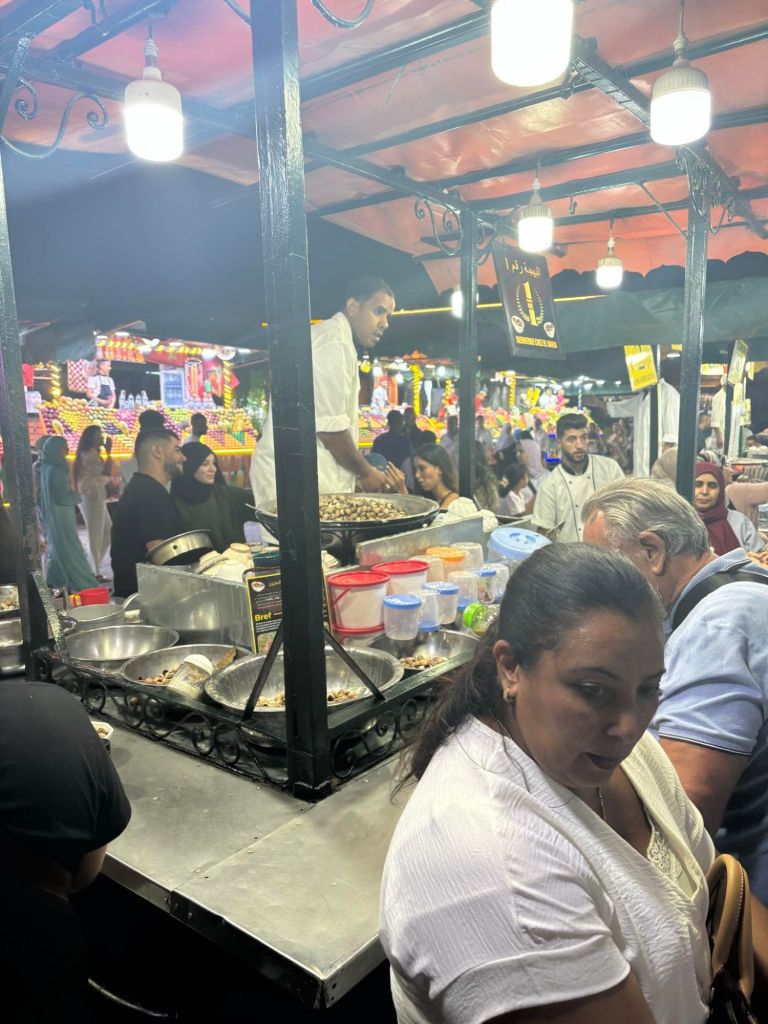
The aroma from camel heads cooking on a spit drifts across the square, and fresh snails being plucked from their shells becomes a familiar sight.
Although the scene is very intense, it is also magnetic and exciting. I love the energy in Jamaa El Fna after dusk, but some people find it too overwhelming. They prefer to sit at the edge of the square, away from the crowds, and watch everything from a safe distance with a drink.
Jamaa El Fnaa at dusk is unlike anything else you may have experienced. There is so much to see.There are games being played, and a few little scams are taking place to try and trick you into coughing up a few dirhams.
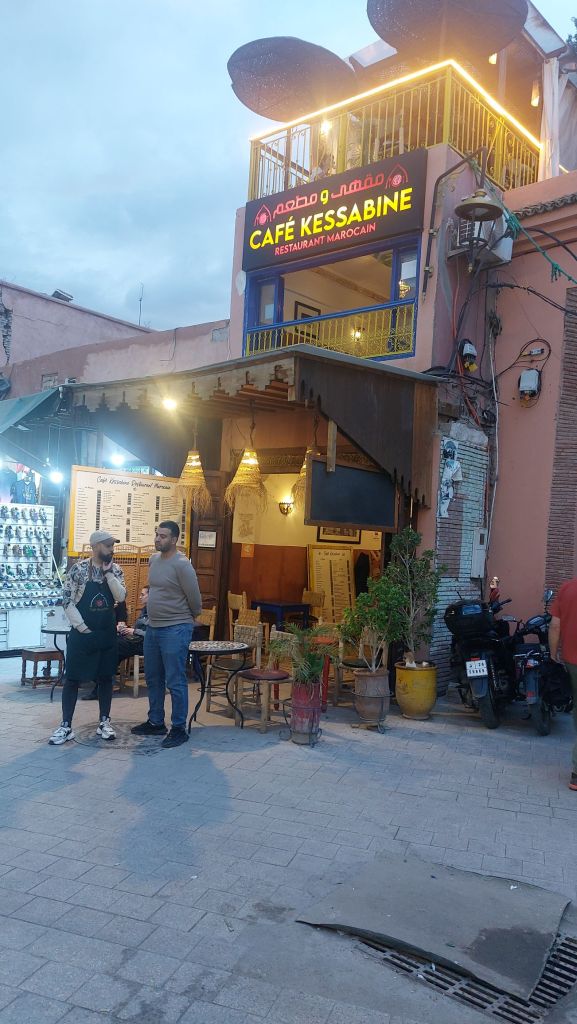
Locals hang around the cafe de France, chatting with each other over coffee. Families wander around the stalls that are brightly lit up and open until late. Young men enjoy kicking a football against the walls of the medina, and couples sit on benches chatting to each other in the warm evening air.
Sugarcane and fruit juice are sold by lively vendors, and the banter is all done in high spirits. Tourists dine on rooftop terraces as the Koutoubia mosque rings out the call to prayer.
As the sun sets, the crowds flock, and the atmosphere becomes electrifying.The square is transformed into a social hub where anything is possible and everything appears to take place at the same time. It’s an incredible experience.
Dazzling bright lights from the open air food vendors and Morroccan lamps for sale on blankets give off a warm, inviting glow. The heady fragrance from incense cones competes with the smell of food cooking, each wafting through the air on a gentle breeze.
Henna ladies sit waiting for unsuspecting tourists and then grab their arms in an attempt to sell them a tattoo. They tell you,”It’s a gift,” but don’t you dare to walk away without paying once they’ve applied it.
You can hear the sound of the gnawa musicians playing dressed in their brightly coloured clothing, belly dancers perform, and acrobats show off their skills to the gathering crowd of curious onlookers, you can’t escape the mayhem. After all, the famous Jamaa El Fnaa is the heartbeat of the city, and it draws you in because it’s a special place and there’s nowhere else quite like it.
Image by Freebird Tracey.
Jamaa El Fna magnetises you. The chaos that surrounds you is an assault on the senses. It’s an experience, an education, and a head-first dive into the rich culture of Marrakech.
Image by Freebird Tracey.
Although there’s so much going on after dusk, please be mindful when stopping to take photos. Someone in the thick of the action will be eagle eyed enough to catch you. They are continuously on the lookout for tourists who have stopped to watch. They will pounce upon you from out of nowhere, with a cap in their hand expecting a donation.
After sunset, it’s as though the whole of Morrocco has come out to play in Jamaa El Fna, and they are determined to have a good time. It’s a sight to behold, lively, energetic, colourful, aromatic, and incredibly loud. Be sure to visit this remarkable place and witness what it is that makes Marrakech so magical. It’s certainly an eye-opener.
Although it’s mostly safe around the square, exercise the usual caution in large crowded areas and try to avoid any obvious scams.
One thing that is central to Morroccon culture is the hammam.
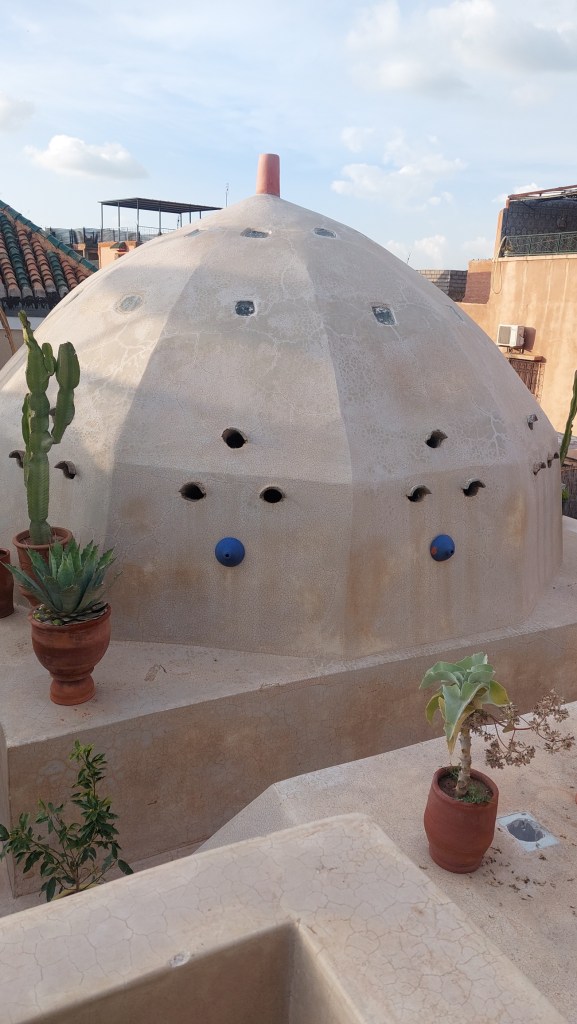
A hammam is similar to a Roman bath and dates back centuries in morrocco. It is a ritualistic cleansing that people do before prayer. This is the reason many hammams can be found near a mosque.
Before homes had plumbing, a communal hammam was the place where Moroccan people went to bathe. They were a sacred space where people gathered to socialise and relax, separated by gender.
Image by Freebird Tracey.
Hammams are still widely used in Morocco today. They’ve become increasingly popular with tourists who wish to learn more about the country’s fascinating culture.
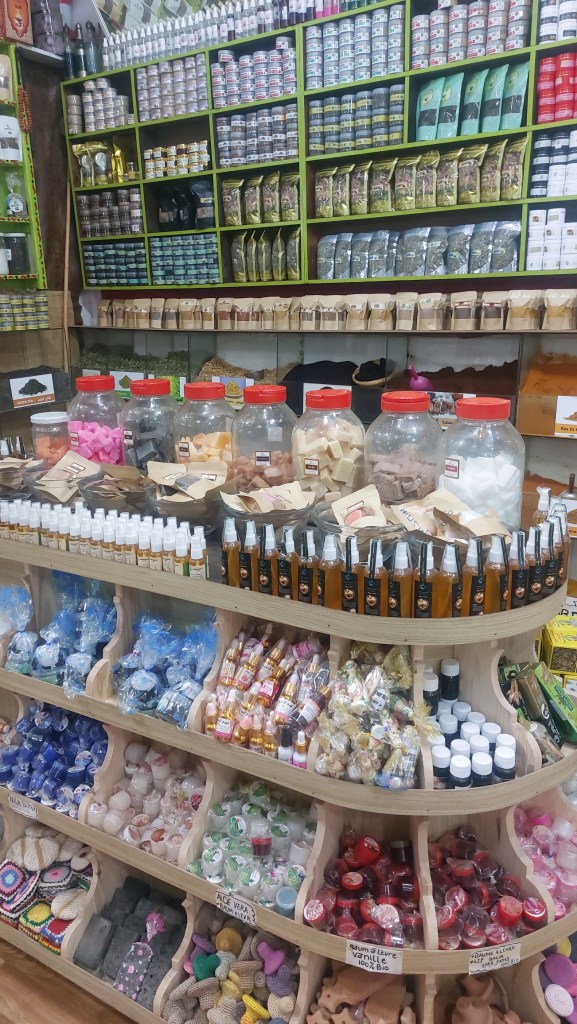
The treatment always begins in a dry steam room. Heat opens up your pores and prepares your body for scrubbing. Morroccan black soap is used to scrub your body vigorously. It is a grainy soap made from olive oil and macerated olives, perfect for exfoliating and removing dead skin cells.
Traditionally, scrubbing is followed by throwing buckets of water over you to wash off the black soap. In a public hammam, buckets of cold and hot water are thrown simultaneously, which can be very invigorating.
In some of the luxurious private hammams, Rassoul clay from the high Atlas mountains is used to cover your body. It contains rich minerals such as silica, magnesium, and calcium, which is good for the skin. Next, your body and hair are lathered with a gentle soap or gel to wash off any residue. This is the final part of the cleansing ritual.
Once your body and hair are thoroughly exfoliated and clean, you receive a massage using fragrant oils such as rose or argan oil. This is an intensely relaxing experience.
Once the treatment is over, you are encouraged to relax with a pot of mint tea and morroccan pastries. The fragrant incense filling the room induces a calm and relaxing ambience.
There are two options for experiencing a hammam in Marrakech. One is a public hammam, and the other is a private one.
A public hammam is a true taste of Morroccan life, where local people bathe together chatting in darija,the Arabic dialect spoken in Morocco. Sometimes, women take their children in, and the atmosphere is friendly and welcoming. When you use a public hammam, you have to purchase your own soap and oils to take in. Using a public hammam is less expensive and one of the best ways to immerse yourself in the life of local people in Marrakesh. Public hammams are perfect for travellers on a budget, but don’t expect any frills. However, they are up close and personal to the customs and traditions of Moroccan people.
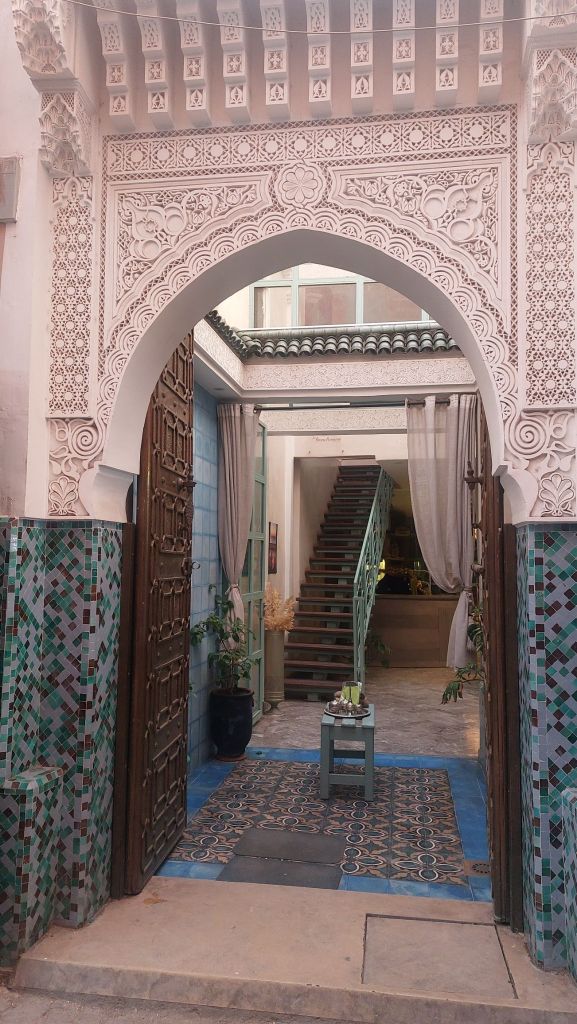
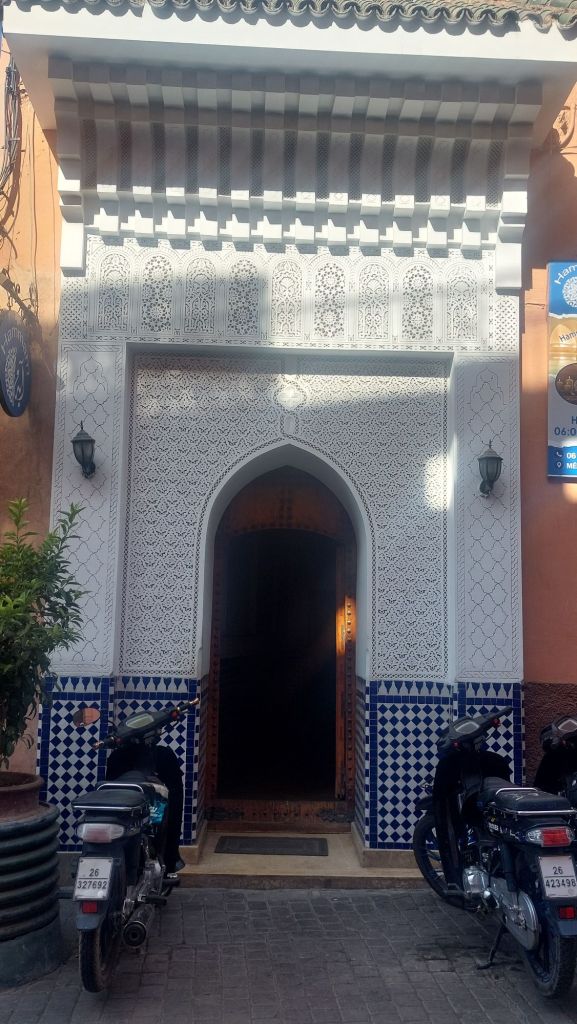
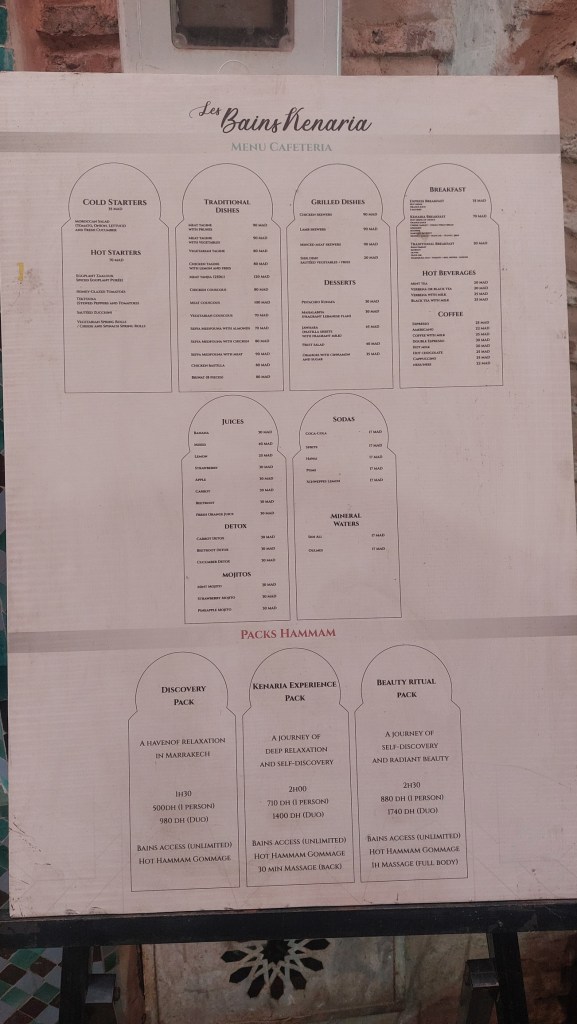
On the other hand, private hammams provide you with everything you need. This includes soaps, massage oils, disposable underwear, a bathrobe, and sandals. Treatment options will vary, from the length of treatment to which kind of massage you prefer. You also get to choose which oils you would like. Interior decor can be quite luxurious, including exotic plants and comfortable couches to relax on. You are welcome to stay for as long as you want once the treatment is finished and some hammams serve food. Les Bains Kenaria is a prime example of a hammam with tranquil surroundings and good food.
It’s worth pointing out that the underwear given to women is very flimsy. Some women ask for the male underwear instead. Nubies sometimes feel vulnerable in front of strangers with only a thong hiding their modesty. However, the rooms inside the hammam are dimly lit, and the Kassalas working there are very discreet. Most women soon get over their initial shyness.
Hammam Mouassine is the oldest hammam in the city of Marrakesh. It opened in 1562 and can be found by the Mouassine fountain, close to the secret garden. Many riads also have a hammam, and this service is available for guests to book.
Here are a few hammams in Marrakech you might wish to visit,
. Hammam de la rose.
. Mamounia Hamman..
. Les Bains Ziani.
. Les Bains Kenaria.
Palm oil is sometimes used when washing hair, so if you don’t agree with the use of it, check beforehand.
Visiting a hammam has been an ancient ritual that has been part of Morroccan culture for centuries. Experiencing a traditional hammam is a break from the chaotic souks and Jamaa El Fna. It can be a relief from the baking heat in Marrakech and a chance to slow down from the manic pace. Tourists who visit a hammam come away feeling refreshed, invigorated, and relaxed. Some tourists even become hooked, expressing it’s an unusual experience,difficult to describe in words, but they feel amazing afterwards and can not wait to go again.
Images by Freebird Tracey.
If possible, I recommend paying a bit more for a private hammam, especially if it’s your first time. You feel less self-conscious because they’re similar to spa treatments in the West. It’s possible to book this kind of hammam through Get Your Guide, and they can come and collect you so you know where to go.
If you want a taste of true Marrakchi life head for a public hammam. They’re budget friendly, and you can buy Morroccan black soap and other items you’ll need in the souks or the spice square. Don’t forget to take a towel, bathrobe and some fresh underwear in with you.
Ben Youssef Madrasa was once the largest and most important Islamic college in Morocco.
It was commissioned by Saadian Sultan, Abdellah al- Ghaleb Assaadi in 1564-65 and named after the adjacent Ben Youseff mosque.
It’s a fascinating place to visit with invaluable historical and cultural significance. The spectacular architecture inside the Madrasa is simply breathtaking and a testimony to the beauty of Islamic art and craftsmanship.
Students who studied at the Madrasa would learn many subjects, including religious science, mathematics, philosophy, and medicine.The Madrasa attracted the best scholars and thinkers from the Arab Muslim world.
Images by Freebird Tracey.
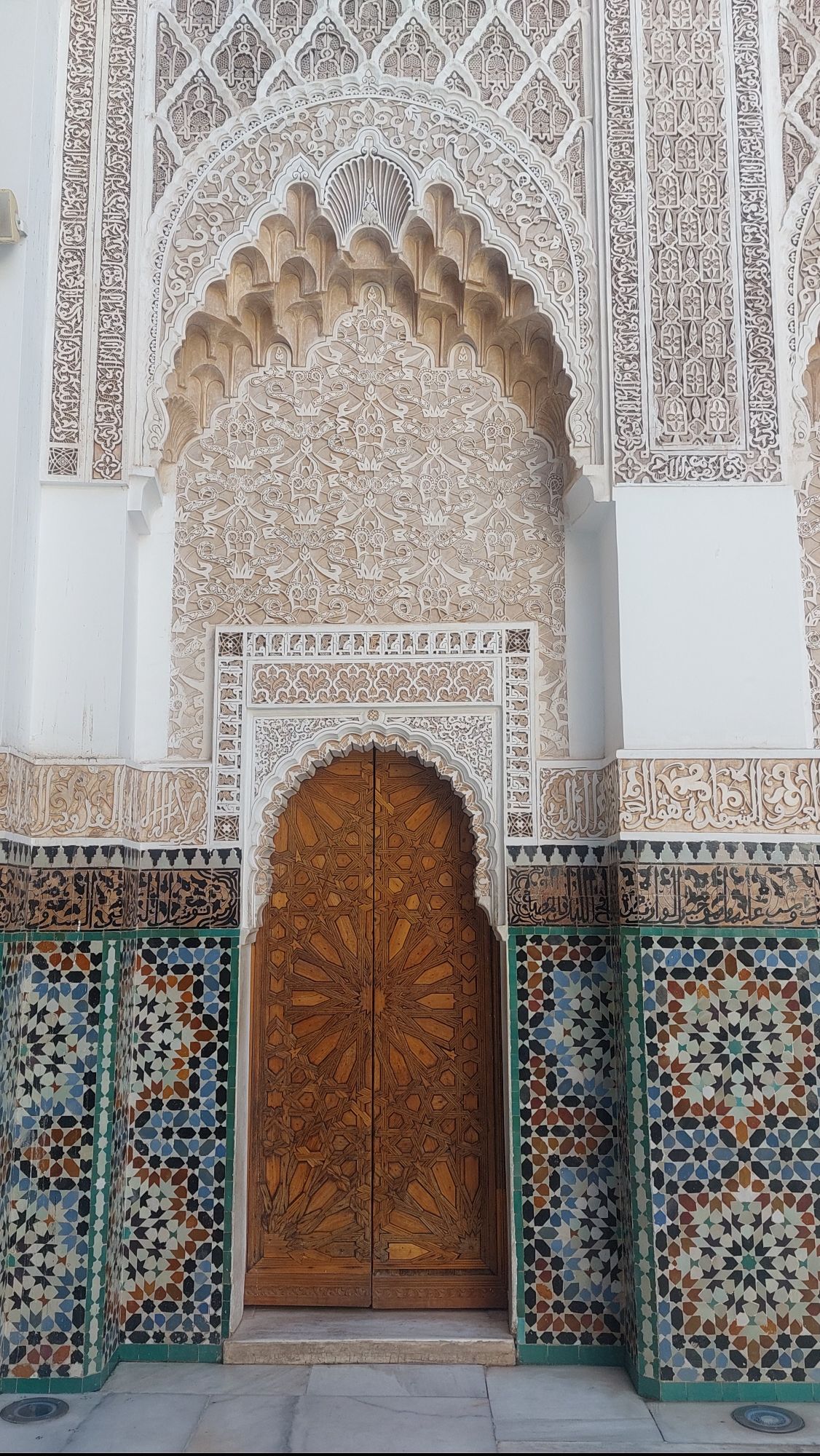
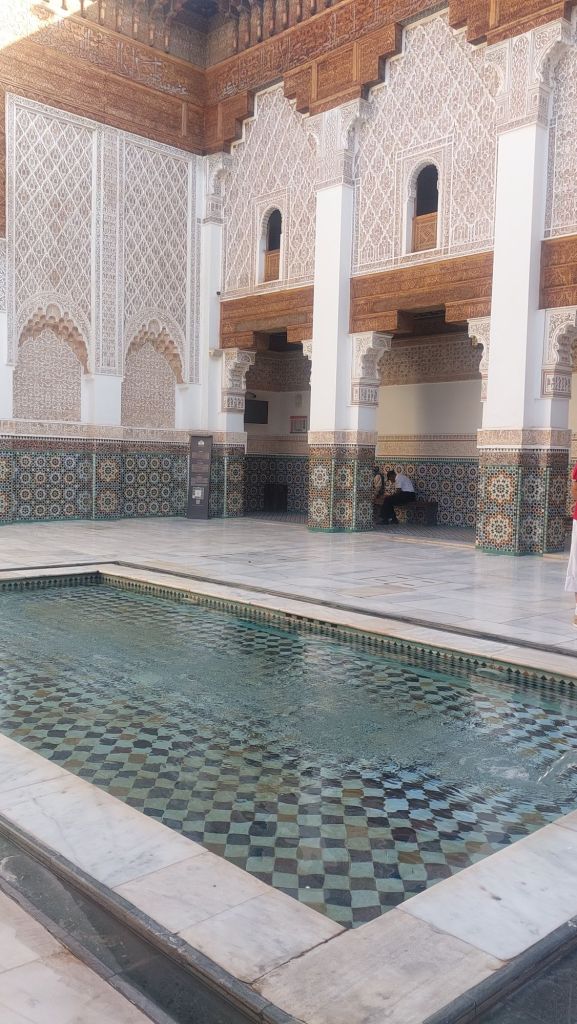
Ben Youseff Madrasa has been beautifully restored. Zellige tiles decorated with floral, geometric motifs and Arabic scripts adorn the walls. Carved cedarwood doors, ceilings, and intricately crafted pillars showcase the quality of the craftsmanship. It’s a prime example of the skill used to create traditional Islamic architecture.
There are approximately 130 dormitories and in it’s heyday as a koranic school, the Madrasa housed around 900 students.The small rooms were just big enough for them to roll out their mats to sleep on.The main focus for each student was study and prayer.
The rooms overlook the large courtyard, and tourists cram inside to have their photos taken standing in the window frames.
Images by Freebird Tracey.
Ben Youseff Madrasa is one of the most touristic sightseeing spots in Marrakech. Due to its popularity, you have to get there early to appreciate the serene environment that the students would have lived in. If you arrive later in the day, expect huge crowds to jostle with each other for perfect photo opportunities.
I visited at opening time, and although there was a small queue of people waiting to enter, it wasn’t too packed with tourists.
Ben Youseff Madrasa is next to Marrakech Museum. The address is Rue Assoual, Marrakech 40000.
Image by Freebird Tracey.
Opening times are 9.00 am until 7.00pm, except on Tuesdays when they close at 4.30 pm. The entrance fee is 70 dirhams.
There are guided tours available to book online. Some include skipping the line entry. I didn’t bother booking a tour. There is information inside the Madrasa, which gave me an idea of what it would have been like to study there. For a more detailed history, a reputable, knowledgeable guide would be helpful.
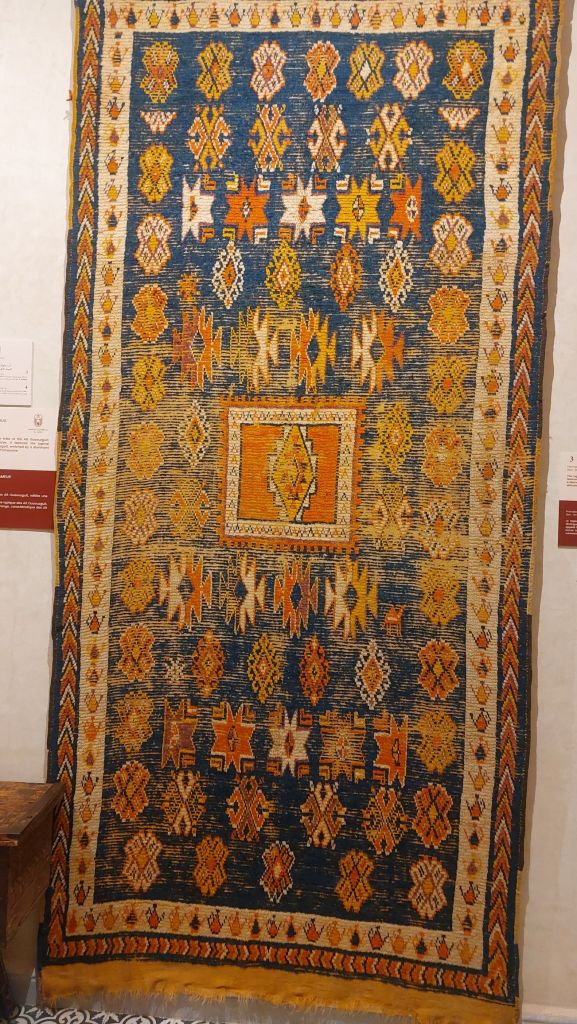
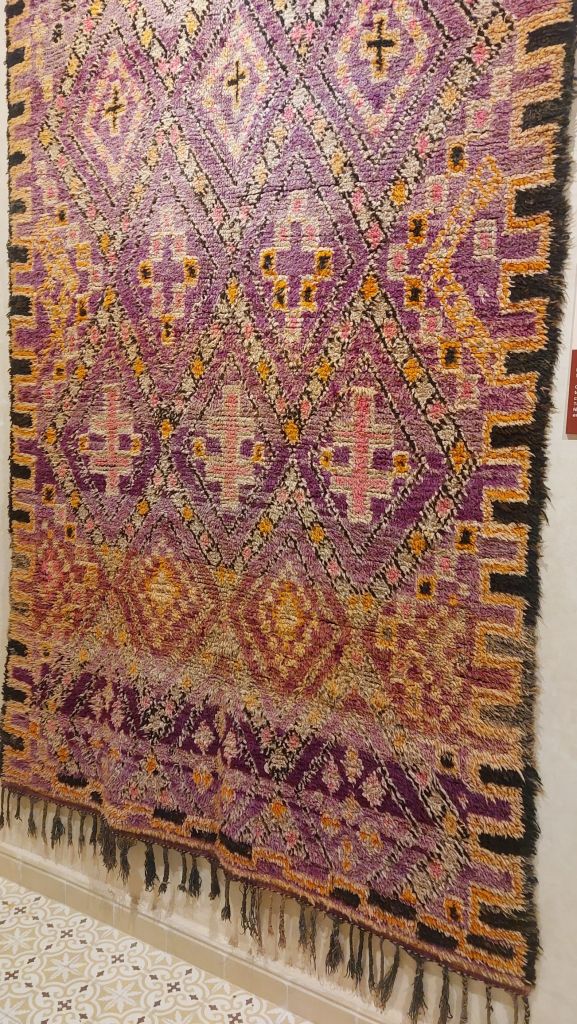
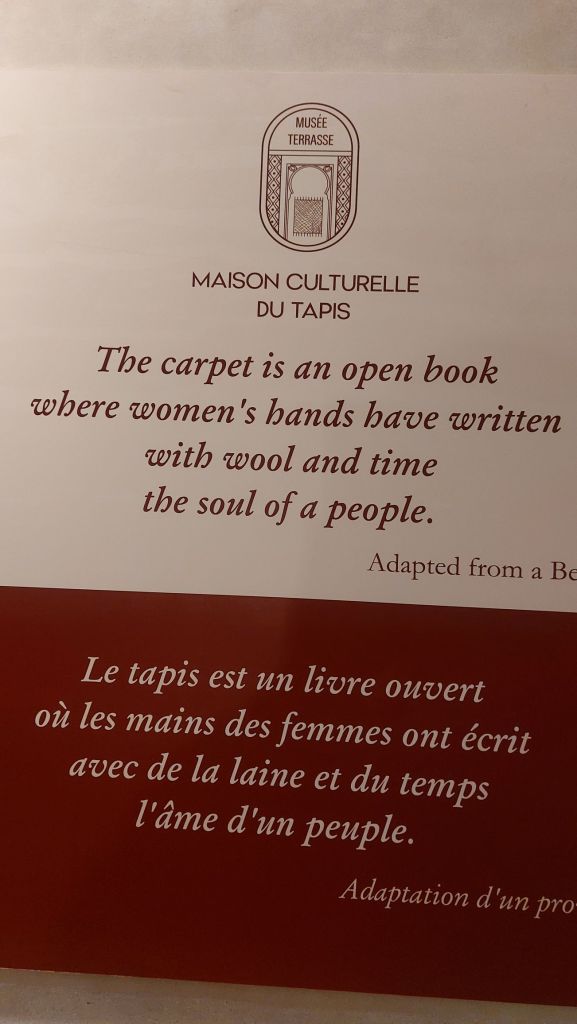
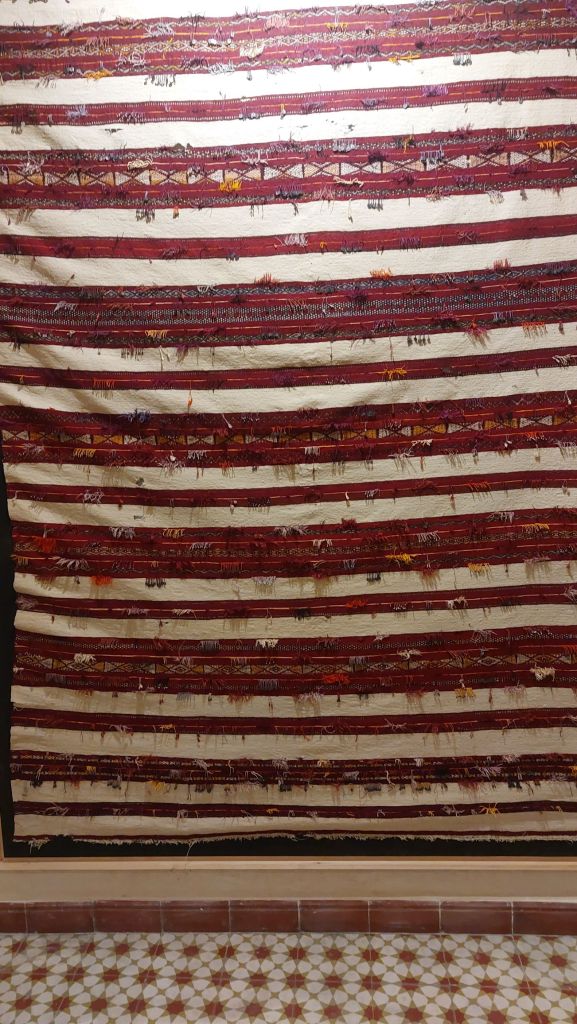
Maison Culturelle du Tapis is tucked away in the souks and a place you must see if you’re in Marrakech. It’s a museum containing a remarkable exhibition of Berber carpets and a journey through the ancestral history of the tribes who created them. Beautiful carpets are draped along the walls of this boutique museum, each one made by different tribes and eras in Moroccan history.
Situated deep within the medina at 16-18 Derb Deffa Ourbaa, it’s slightly hidden, but the vendors in the souk will point you in the right direction if you struggle to find it.
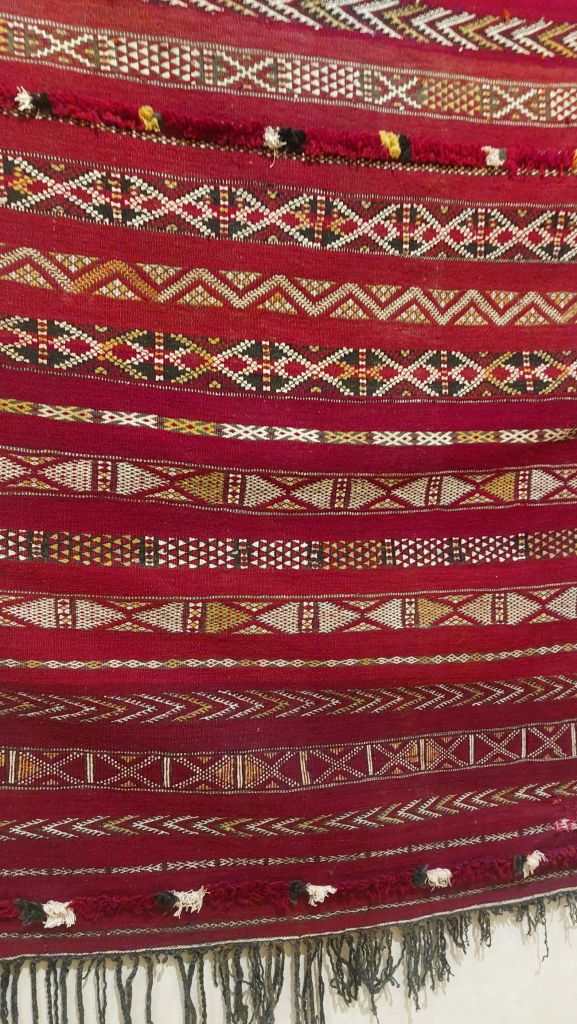
The museum is a fascinating walk through the history of traditional carpet weaving, and some of them on display are generations old. They have been beautifully preserved, and each one is a testimony to Moroccos weaving heritage.
Images by Freebird Tracey.
Every room of this tastefully restored 17th century riad invites you to look at each different region’s identity, from the Atlas Mountains to Rabat. You get to learn the meanings of Berber symbols and the specific colours each tribe used when weaving their carpets. Each carpet is unique and tells its own story.
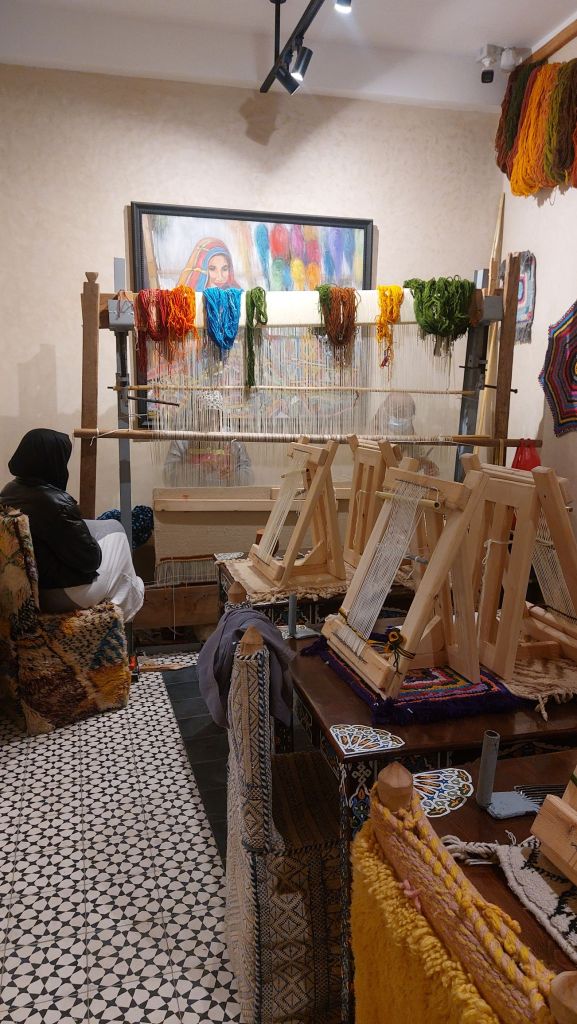
There are descriptions to help you appreciate the work that goes into creating each piece, including a detailed history about the Berber tribes who produced them. There’s also an interesting video showing you the process of creating the carpets and the history of the Berber women who spend months skillfully weaving each piece.
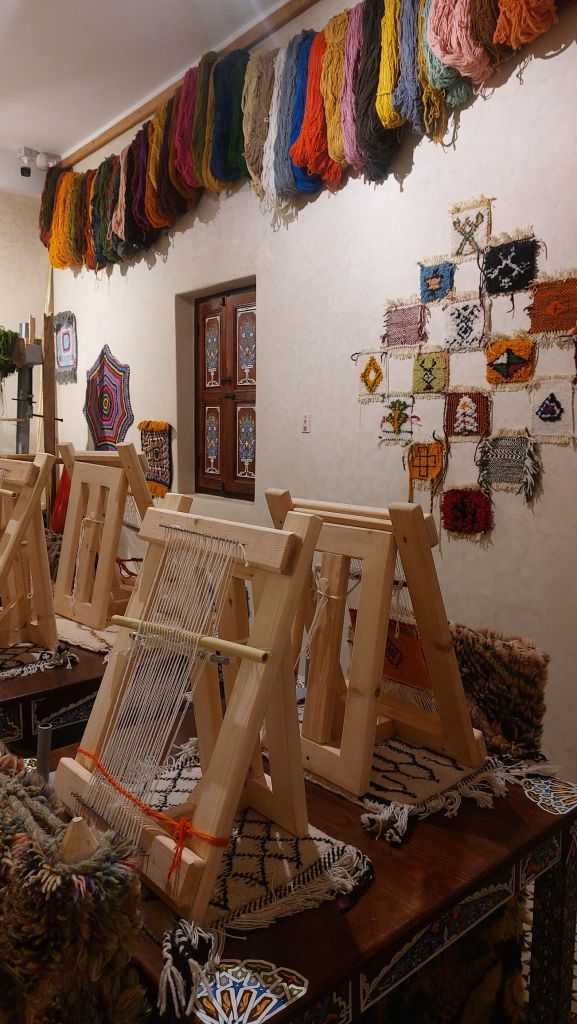
On the first floor, you will find a workshop where you can have a go at making a small tapestry to take away with you. This is a two hour activity and ideal for families.
Images by Freebird Tracey.
One of the treasures on display in the museum is the Rabat carpet, a symbol of royal elegance renowned for its rich decoration and finery.
The museum also houses a collection of exquisite rare 20th-century carpets and modern contemporary pieces.
Images by Freebird Tracey.
A visit to this delightful place was a nice break for me from the densely packed medina, and I would thoroughly recommend stopping by to have a look around it.
There’s a small shop inside the museum selling rugs, cushion covers, and bags with pieces of woven tapestry stitched into the centre. They are the perfect souvenir or gift to take home with you.
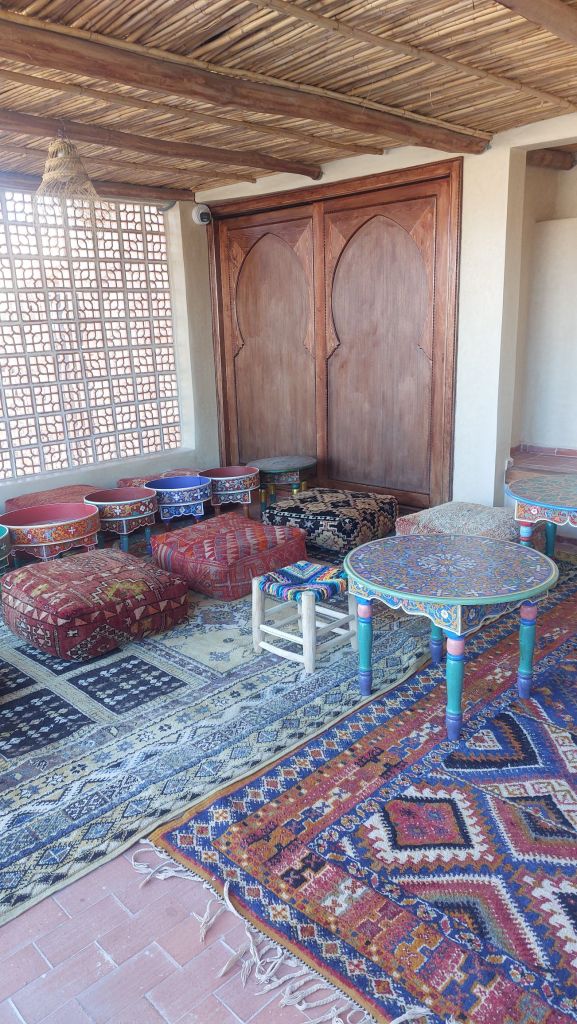
After exploring the museum, you can relax on the pretty rooftop terrace, where you’ll find a nice cafe to have a light snack, homemade pastries, or a drink. The views across the medina from up here are incredible.
Images by Freebird Tracey.
The museum is open from 10.00 am until 6.00pm and there’s a small entrance fee. It’s definitely worth every dirham to delve into the rich, cultural ancestry of the Amazigh and learn about their exceptional carpet weaving skills. Highly recommended.
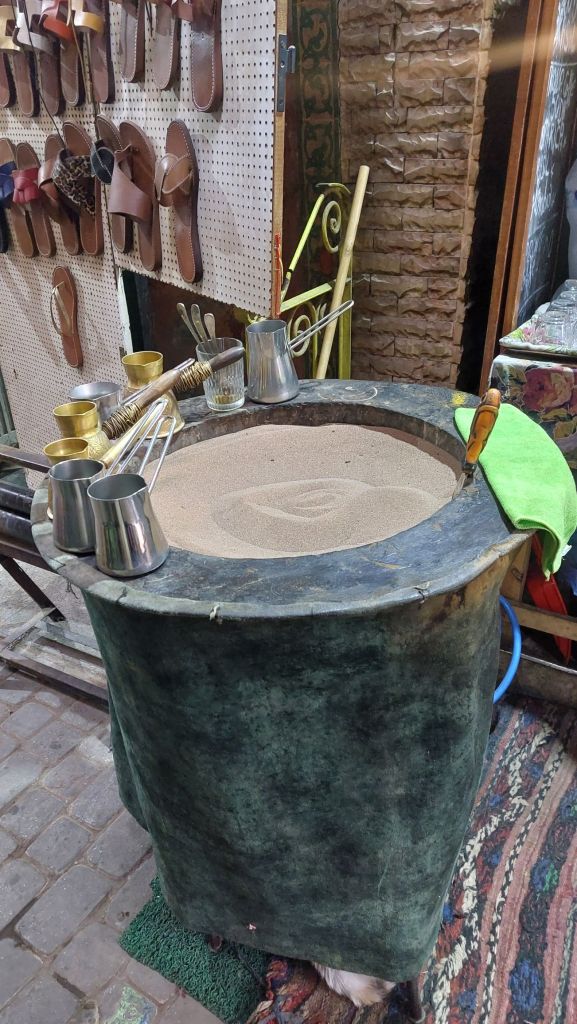
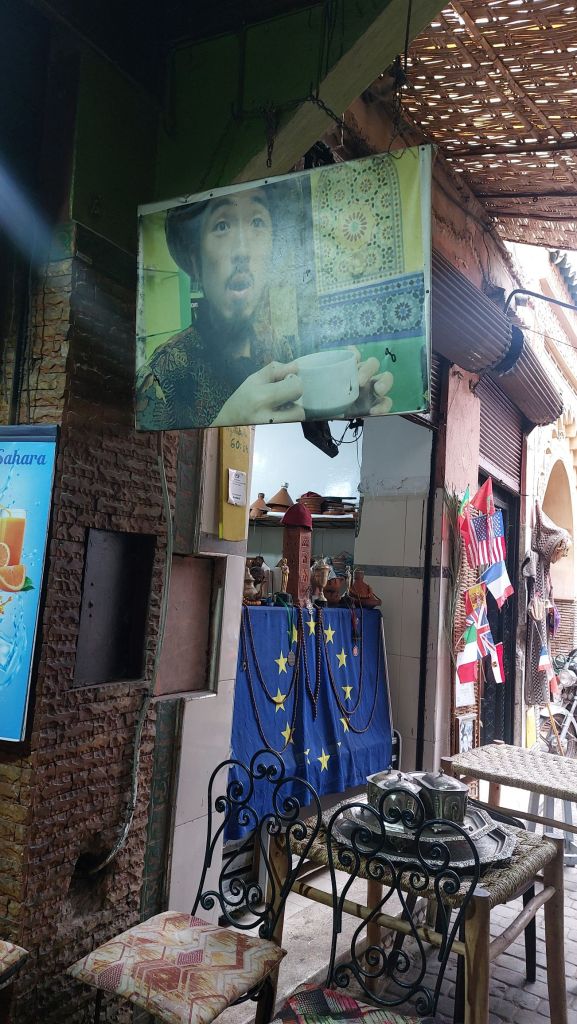
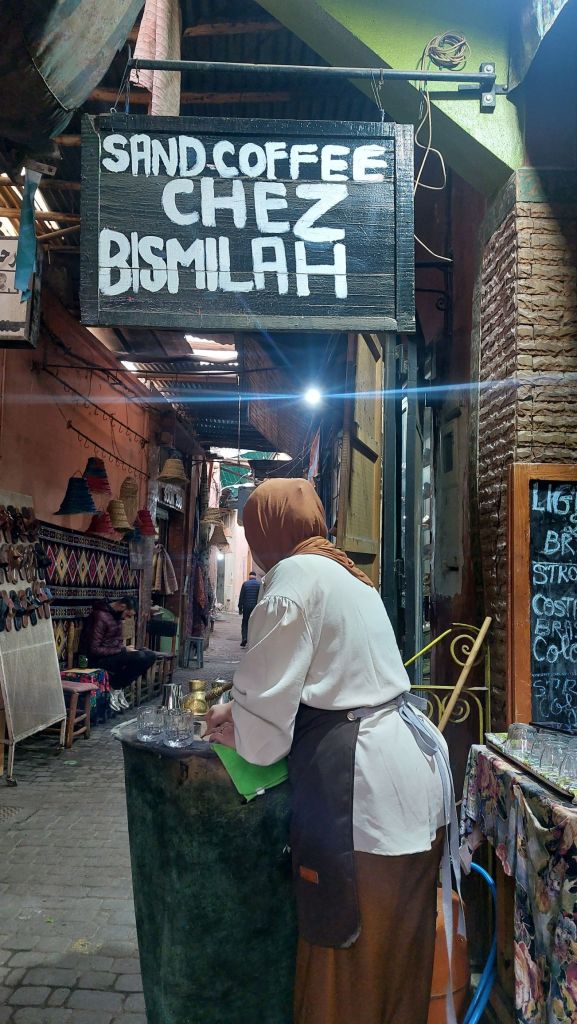
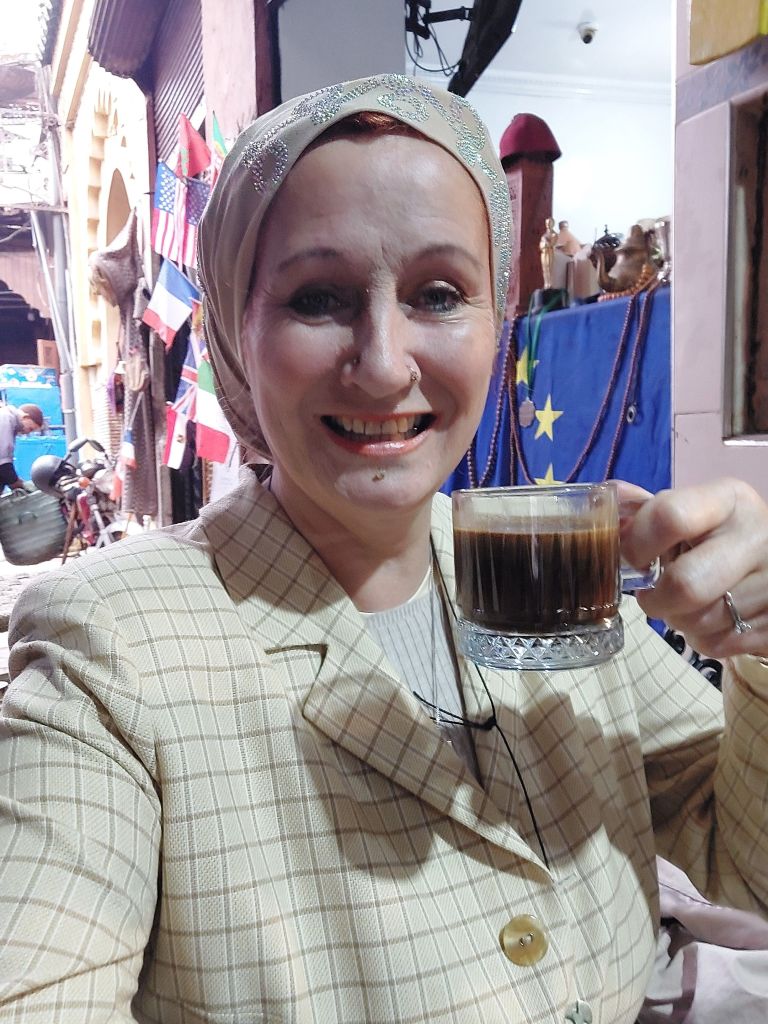
Chez Bismillah Sand Coffee is a hidden gem inside Souk El Kebir. It is here that rich aromatic coffee is brewed using hot saharan sand, gently spiced with a touch of Cardamom, Turmeric, or Cinnamon to give it a distinct flavour.
To make it, the coffee is added to iced water inside small brass pots and then heated by moving it around by hand in hot sand. It’s an ancient technique of brewing coffee that involves no electricity, simply hot Merzouga sand.
The coffee has a rich, dense, creamy flavour unlike any other coffee found in the medina. It is soothing and velvety.
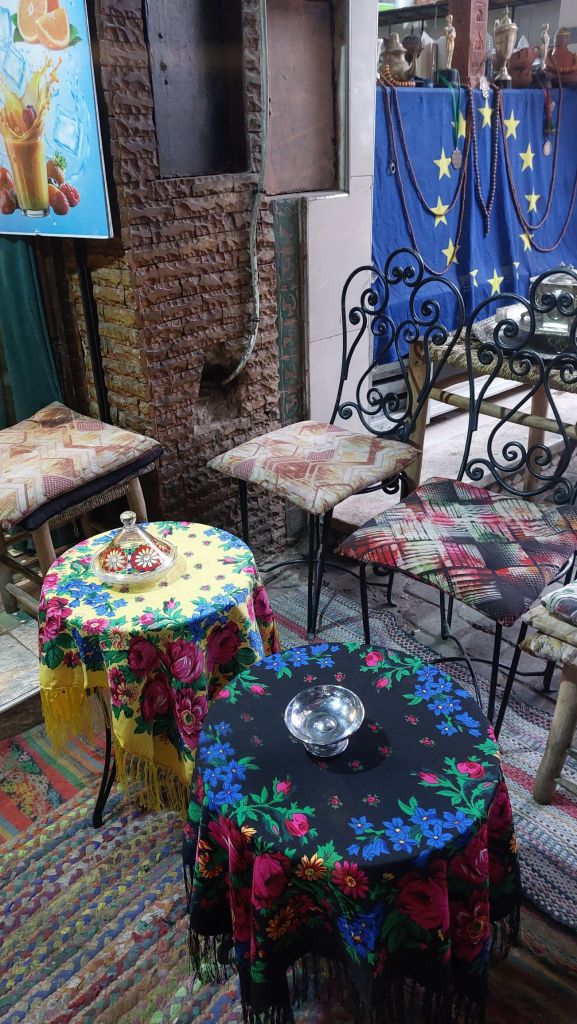
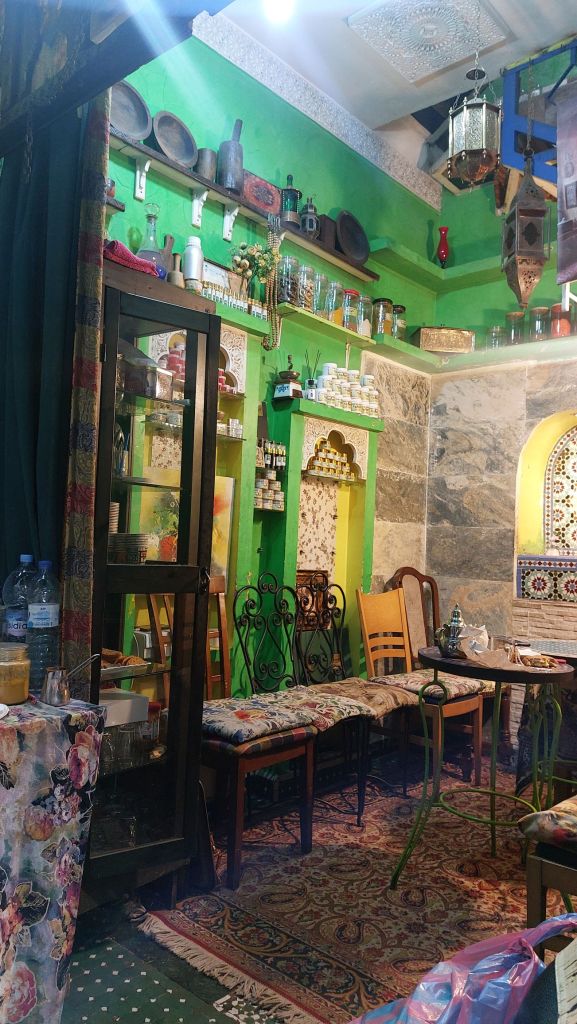
This charming little spot is humble in appearance, cosy and inviting. There is a small rooftop terrace where you can sit and enjoy your coffee in peace, a moment of sheer self-indulgence
Images by Freebird Tracey.
Chez Bismillah offers you a serene refuge where you can sit watching the medina come to life tucked away in a quiet space away from the crowds.
It’s an experience watching the coffee being made from rich arabica and fragrant spices. In moments, it has heated up as if by magic. I savoured its unique taste whilst congratulating myself for finding this amazing discovery in the alleyways of the souks.
Chez Bismillah is a unique experience firmly rooted in place and tradition. The friendly proprietor gives you a glimpse into a past that conjures up images of camel traders selling cloth in the fondouk and stretches of vast desert terrain.
Images by Freebird Tracey.
It’s not just a cup of coffee. It’s an escape from reality, a moment of peace from the hectic rhythm of the busy souks.
Chez Bismillah Sand Coffee can be found at 193 Souk El Kabir, it is open daily from 9.00am until 9.00pm with the exception of Saturday and Sunday when it closes at 7.00pm.
Take a trip to a vast stony desert near Marrakech.
Image by Freebird Tracey.
We met our tour guide near Jamaa El Fna at 6.00pm and boarded our air-conditioned mini bus.We were a small group of 8 people, and the journey took around 45 minutes.
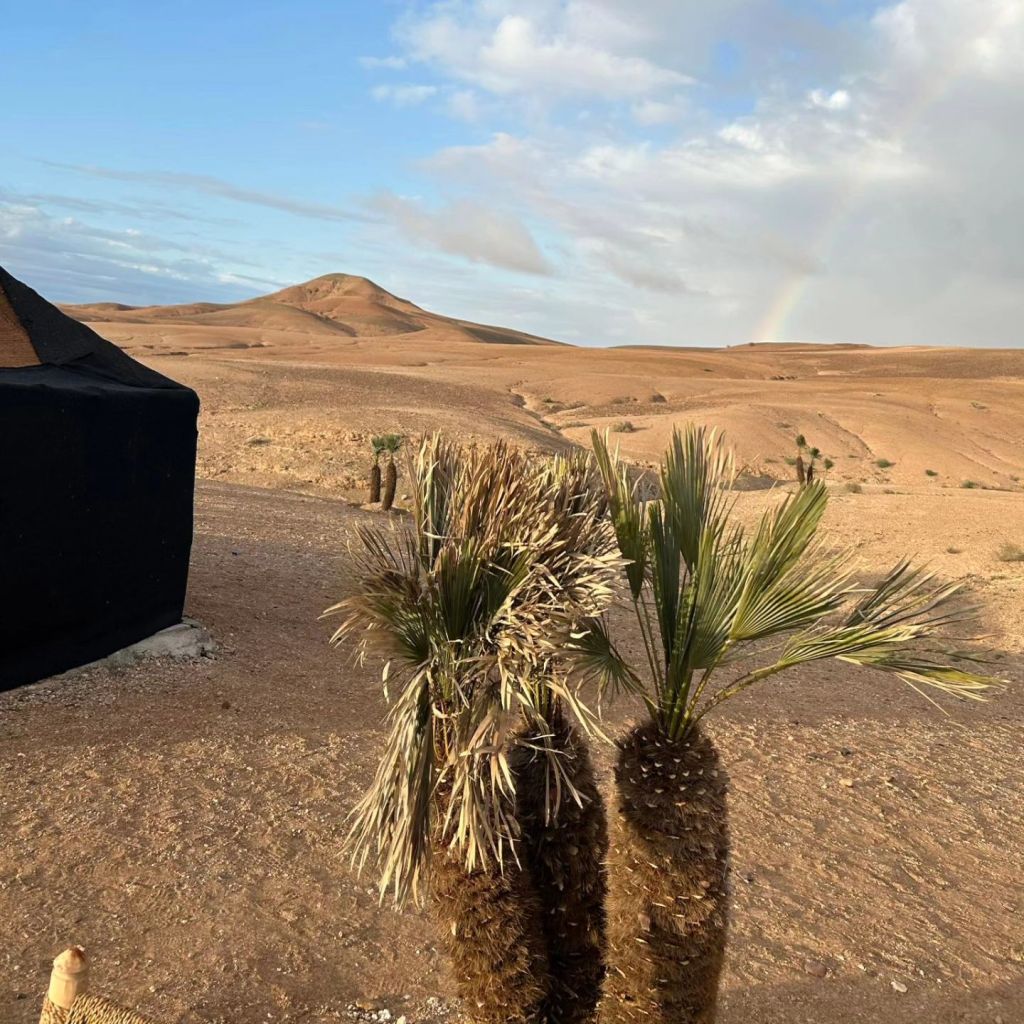
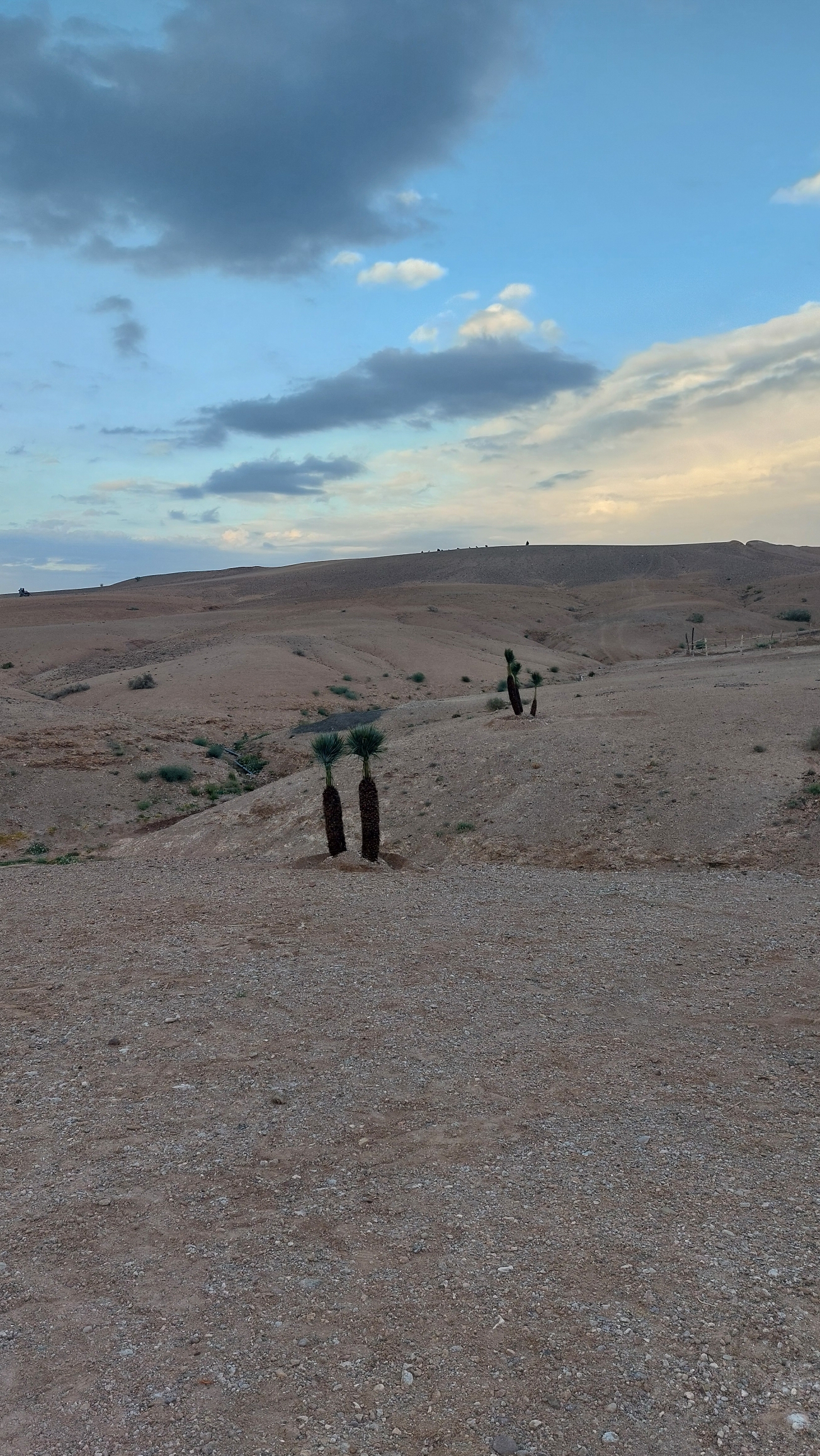
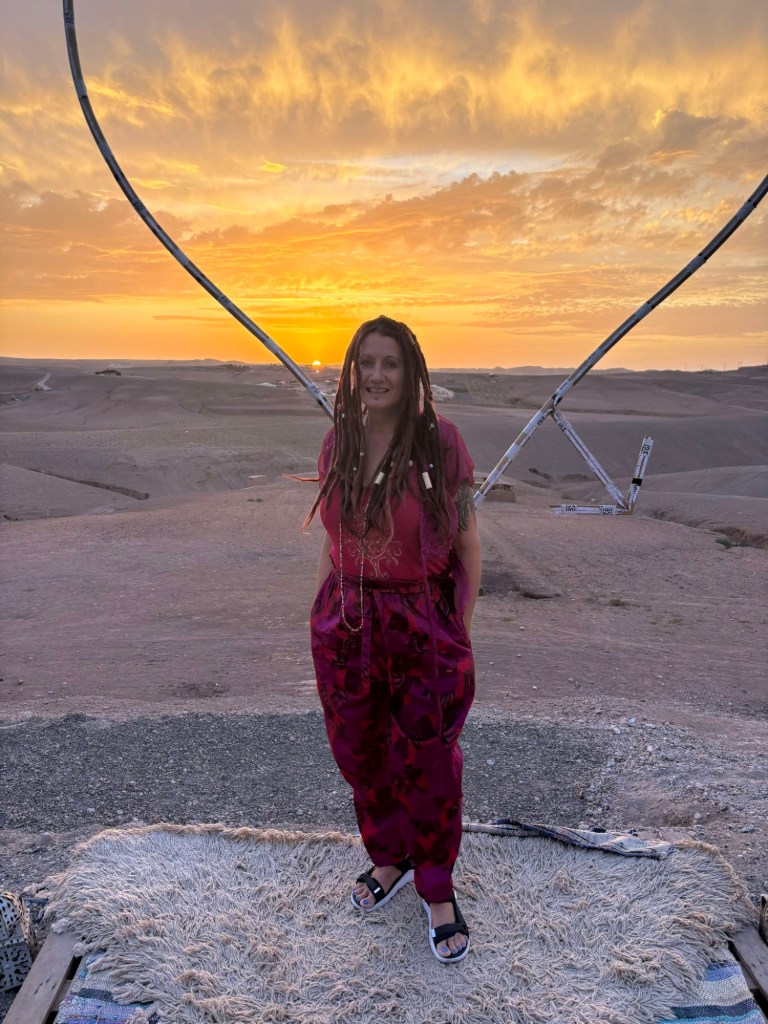
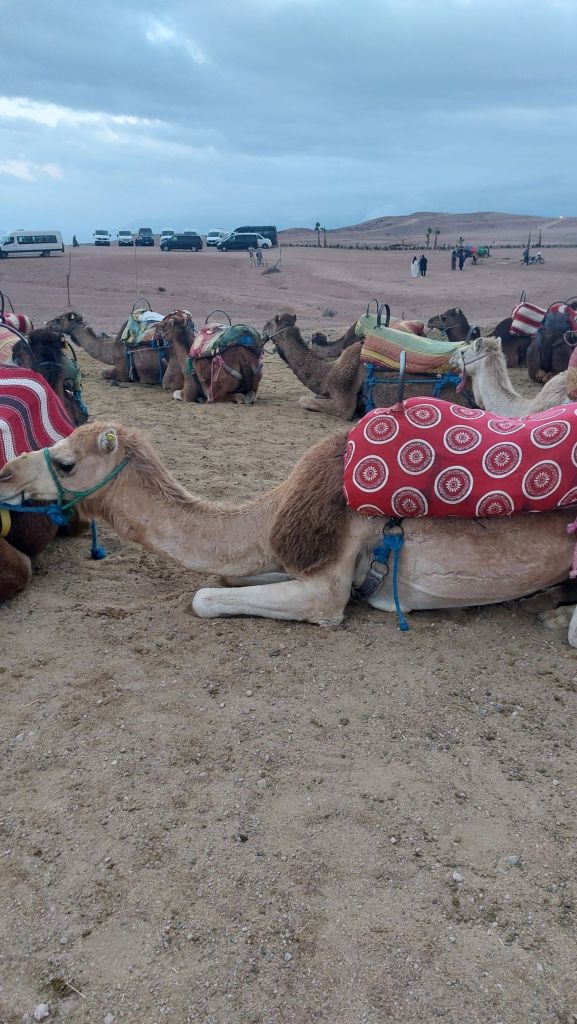
Agafay desert is a gravelly desert, composing of stones, rocks, and dunes where some vegetation is able to survive. As we approached our camp, camels sitting with their calfs looked fairly nonplussed at the convoy of tourists descending on their territory.
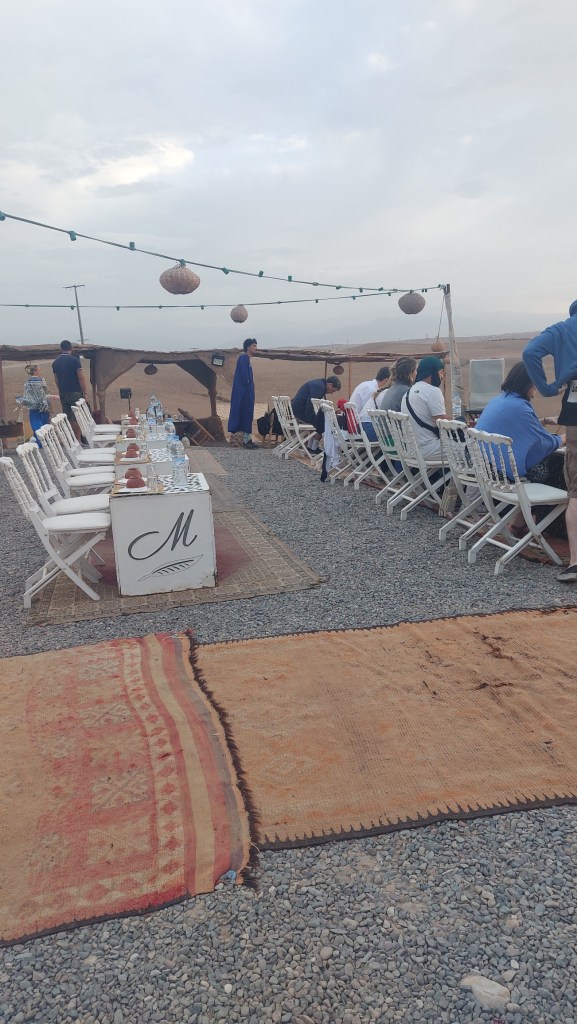
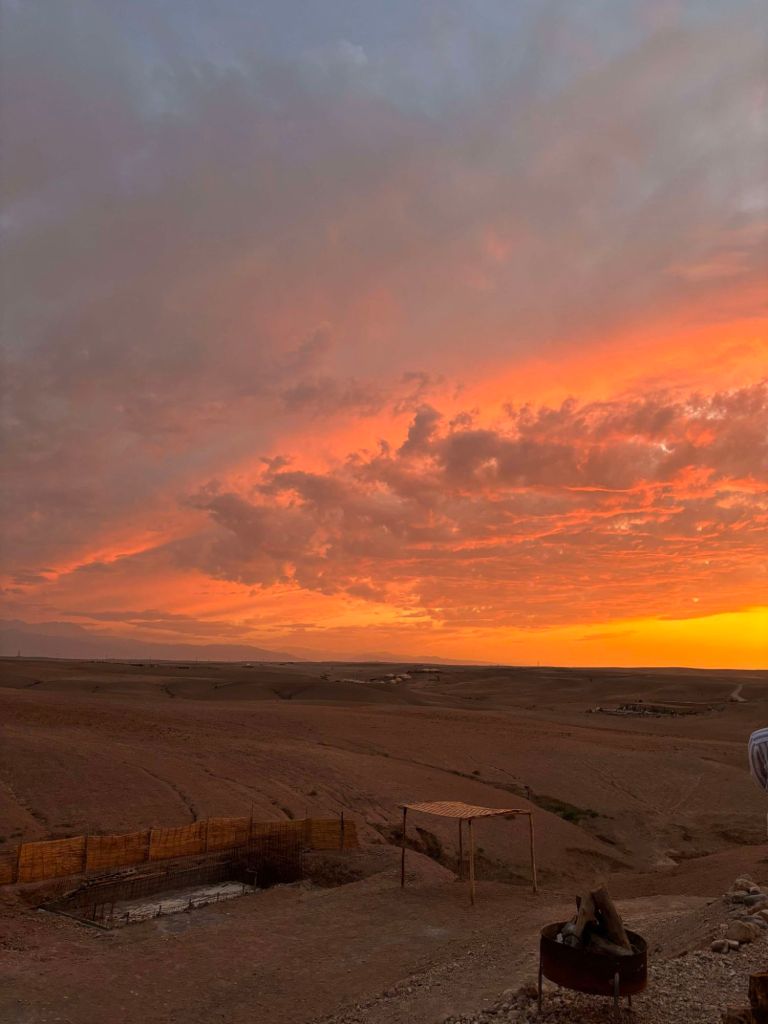
As we disembarked, the sound of traditional gnawa music was playing in the distance. Our guide led us to tables that overlooked the vast expanse of desert. The panoramic view laid out before us was absolutely breathtaking.We could see for miles.
Images by Freebird Tracey.
Our camp was pretty, with colourful cushions and rugs scattered about and rattan lamps hanging overhead. There was a large Berber tent where you could shelter from the breeze.We could eat inside the tent or at tables in the open air.
After settling in with a mint tea, some of the group took a short camel ride. This activity was optional.
Image by Freebird Tracey.
Next came a three course meal, including vegetable soup served with traditional Morroccan bread, a delicious tagine, and fruit for dessert. The food was tasty, and the fresh air had given everyone a good appetite.
We ate our dinner watching the golden sun go down. The skies were a fiery red. It was one of the most beautiful sunsets I had ever seen.
Images by Freebird Tracey.
A group of Morroccan gnawa musicians played around the tables, entertaining us as we finished off our meals. It was a lot of fun, and everyone was in high spirits.
Video by Freebird Tracey.
As soon as dinner was over, the merriment commenced. Dubious tourists were pulled into a circle and were soon snaking around the campfires attempting Berber dancing. The atmosphere was lively and upbeat. Everyone was clapping along and enjoying themselves. The stars came out in the clear sky as the campfires roared. By now, the temperature had started to drop, but we felt warm and cosy by the big open fires.
When the lively display of Berber dancing was over, we all sat down to catch our breath. The camp was full of laughter, and everyone was having a good time.
The grand finale was next. A spectacular light show in the middle of the desert. Everyone looked on in awe at the amazing pyrotechnic display taking place on a crater in front of us. By now, it was completely dark, and the effects were hypnotising. Watching the flames leap about against the backdrop of the vast dark desert was the highlight of the evening.
The fire display brought the evening in Agafay desert to a close. It had been an exciting evening. We were escorted back to our vehicles and driven back to Marrakech.
The excursion to Agafay desert was great value for money, and I would highly recommend it. I booked my trip through Get Your Guide, but your accommodation will also be able to organise the trip for you. There are a few different desert camps to choose from, and some have better facilities than others, so check the reviews before booking. Quad biking is also available if you prefer that instead of a camel ride
It is also possible to book an overnight stay at Agafay Luxury Camp. The camp offers a swimming pool and luxury accommodation with showers and bathtubs. Details can be found on Booking.com or by looking online.
Here are a few things that you may wish to consider if you plan to visit Agafay Desert.
Take a warm sweater or blanket because evenings drop cooler.
There are plenty of toilet facilities but take some tissue with you in case there isn’t any. You may also want to take some hand sanitiser.
Some tours visit an Argan Cooperative on the way to the desert. If you’re interested in purchasing anything, take some cash with you in case they don’t accept card payments.
The evening tour usually finishes between 9.30-10.00. There may be earlier tours during the winter months.
Agafay desert was an entertaining way to spend an evening. Now that I’ve had a taste of desert life, I am eager to visit the Sahara.
The Palmerai is a 54 square mile palm oasis on the northeast edge of Marrakech. It’s a 20-minute drive from the city centre and is well known for its lush landscape, high-end resorts, and popular activities.
I needed to take a break from the manic pace of life in the medina, so I decided to visit the Palmerai for a camel ride at sunset. I booked the activity through Get Your Guide, and I was picked up at 4.00pm next to the Islane Hotel. I was part of a small group, and we were taken to our destination in a small air-conditioned van.
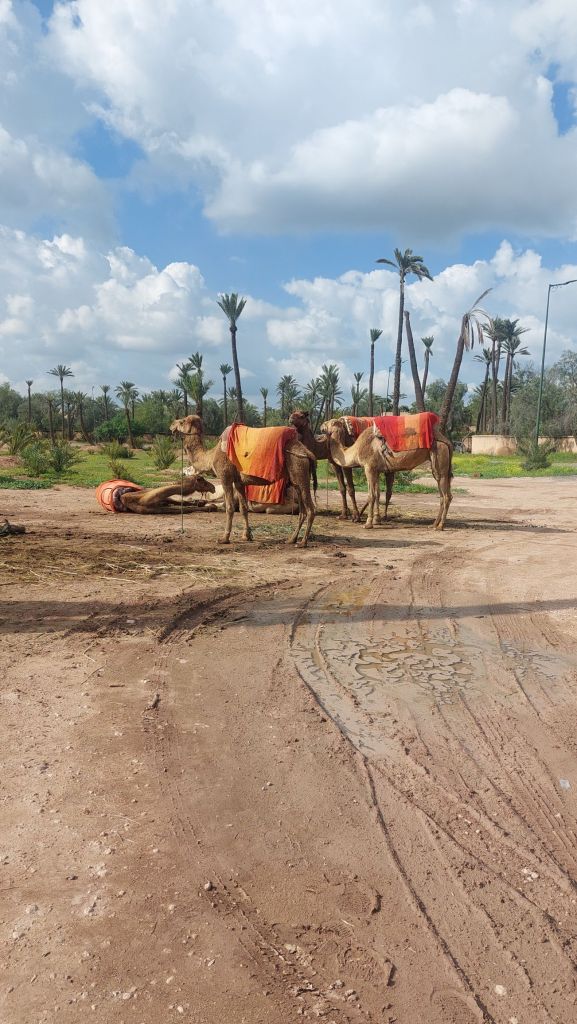
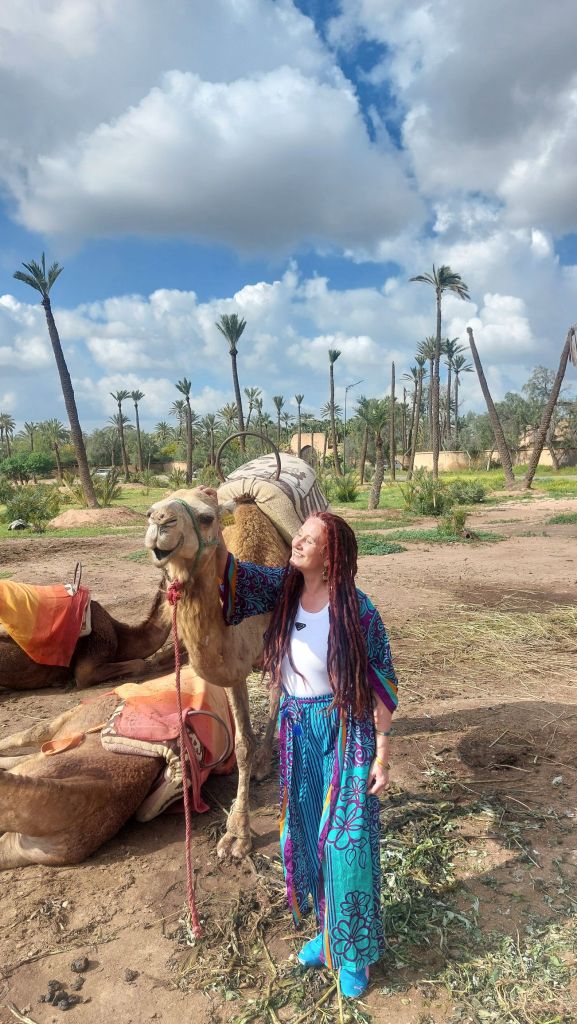
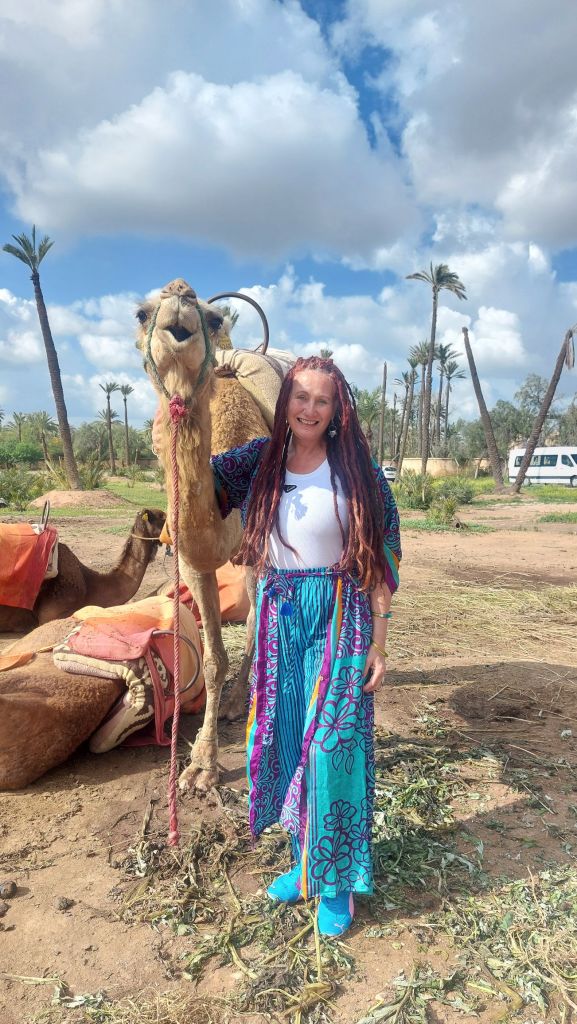
After a short drive, the scenery began to change into open roads landscaped with thousands of palm trees. There were camels sitting at the sides of the road wearing colourfully decorated seats, waiting to take tourists for a ride around the scenic area.
Once we had arrived at our destination, I was dressed in traditional blue Tuareg clothing and helped onto my camel by a friendly camel driver.
Video taken by our guide Mohammed.
Soon afterwards, we set off trekking through the palm groves as the sun began to set. The trek lasted for around 40 minutes across a stretch of gravelly ground.
I have every respect for the Tuareg, who would spend months on the back of a camel in search of salt mines. However, they are not the most comfortable creatures, and 40 minutes was more than enough for me.
Image by Freebird Tracey.
It was late March when I went. Therefore, I imagine the sunset would be more spectacular during the summer months. It was still nice and peaceful, even if I didn’t get the wow factor I was hoping for.
The camel drivers were entertaining, singing songs along the way and making little camels for us by plaiting the grass they picked along our route.
Back at the vehicle, the camel drivers prepared a pot of mint tea for us all. After drinking it, we got back into the van and were soon heading back into Marrakech.
My thoughts on the activity are mixed. It was good to get out of the busy city for a short while, and the scenery was nice. I enjoyed seeing another side of Marrakech, but I didn’t really get the experience I was hoping for. Perhaps it was the overcast sky spoiling my expectations of a dramatic sunset or how swiftly the event seemed to come to an end.
In terms of value for money, I think that quad biking may have been the better option. On a positive note, our guide was lovely. He took videos and photographs for me and helped me into my headscarf.
If I return to this part of Marrakech, I will try another activity. The Palmerai hosts balloon rides, which are available through Paradise Ballooning and Marrakech Balloon. There are several golf courses in the area also.
For people who want to experience riding a camel, the Palmerai is ideal due to its close proximity to Marrakech.